
This is the log so far this year, I will add to it as we go along, but it will not come up as a new post. Look for updates in the Bees and Prairie category on the right.
October 7, 2014 50 degrees, 2:30 pm sunny
Opened both hives to check for winter stores and apply the mite control. Three deep supers going into the winter for both of these.
Hive #3 (that was the divide – no honey from this one) had plenty of stored honey and bees – supposed to have at least 8 frames of honey and 8 frames of bees to get through the winter. Hive had a full deep of honey at least 7 frames, and lots of bees in the two bottom deeps. Deeps are very heavy.
Hive #2 (new package this year) was loaded with bees and also had plenty of honey. Bob can barely lift the deep supers. We put the mite control stuff in the hives in each super. Closed them back up and that should do it. Bob still needs to go out and put in the entrance reducer with mesh to keep mice out.
The only next thing we need to do is put the winter insulated covers on – around Thanksgiving.
September 15, 2014
It was a bad year for our hives. We had so little to harvest that we did not extract it, but just made three little bottles of comb honey — and that was it.
The problem 1) we lost one hive over last winter so that hive was a new package this year. New packages do not usually produce much leftover honey to harvest.
2) We were away for three crucial weeks in June. When we were to leave (the two hives we had were doing great) I was worried the overpopulated one, that made it through the winter, would swarm while we were away. SO.. we attempted a “walk away split” that created two hives from the one. We did not know which part of the hive had the queen, but the best case scenario is the part of the hive with no queen would make a queen. That did not happen for one reason or another (always a mystery with the bees) neither of these hives produced any extra honey for harvesting.
BUT now we have learned a whole lot more about it all and we have two healthy looking hives going into winter with heavy stores in three deep supers. They are in the new relocated bee yard in the woods. We will add a new package in the spring to the hive that did not have a queen and would not make it. Bob disassembled that hive — if there were good workers still functioning, they might find a new home in one of the other hives. But it was probably full of drones from some “laying workers,” females who lay unfertilized eggs that only hatch into drones.
Bob says, farmers have to put up with crop failure sometimes… or something like that
August 7, 2014 We both went out to check all three hives. Started with the one we were most worried about – #1. Unfortunately – not planning ahead AGAIN! I did not have my glasses on, or a magnifying glass, or a camera. We took the whole hive apart – it did not really look good – seemed like not so many bees going in and out, but there were lots of bees in the hive – did see some obvious drones…. But could not make out if there were more than one egg in the cells – saw some drone brood and some other stuff too – also some frames of black capped honey – I scrapped it and it is just honey – looked it up and it said it reflects the color of the honey, so not a problem. It is in the deep supers anyway and not honey that will be harvested, but part of the winter store. So we are still flummoxed – will go and check again with the right vision equipment.
Hive #2 (our new package from this year) is going strong – it has 4 honey supers on but there is still room in the top one, so we are leaving that one alone and not taking it apart. Appears to be doing fine.
Hive #3 (the one from the divide that probably had the original queen) This has three deeps and a couple of honey supers. Took it apart and removed only one frame from the top super and it looked perfect. Good brood field surrounded by pollen and honey. Ok on that count.
July 22, 2014 Bob checked all three hives. He saw a few eggs and lots of capped brood in hive #1, although not much activity in the honey supers. Yay! This means they made their own queen. Hive #2 (the split with the queen we think) nothing in the honey supers and not much in the third deep we added three weeks ago. He did not check the middle deep. He removed the third deep, but we are going to put it back and take off the honey supers and just have that hive try to build up three deeps for the winter. Hive #2 (the new package) lots of honey in the two honey supers and he added two more honey supers – we should have a nice harvest from this hive, but not sure about the other ones.
July 4, 2014 visited the bee yard. Added a deep super to the single super in hive #3 (made from taking one box from Hive #2) looked at the frames in there – lots of bees, but did not see the queen (this one is marked) but they look good, and my guess is this hive has the queen.
Hive #2 added another super – now has three deep boxes (supers) we like to go into the winter with three deep supers – this is where they make honey for their winter stores. This hive already has two shallow supers above a queen extruder, those frames are used only for honey, not eggs. Hive looked good.
Hive #1 – no activity at all in the top two honey supers. Took the hive apart and looked at the frames, lots of nectar but no eggs. I had a feeling this was the hive without a queen. Looked in the middle box and saw evidence of queen cells – obviously making a queen, as they should be – the only down side it that it takes a bit of time to make a queen, then she flies around on her single mating trip, and comes back and starts laying eggs. There were lots of bees in this hive, and I could just sense the emptiness of being queenless. Maybe it is my imagination, but it felt sad. I look forward to going and checking and seeing eggs again – probably not for several weeks, though.
So we are done with all three hives for a while…. Bob could harvest some honey from hive #2 if he wants to – we are thinking we may not get much honey this year. You never know.
June 27, 2014 Back from two weeks away, Bob looked a the hives and said there are a lot of bees and hive #2 is very heavy. Worried about swarming so we did a walk away split on hive #1 – for hive #2 we did not have another deep super, so we moved the extruder up to between the honey supers – at least that may give that hive a little breathing room, although it reduces the honey harvest – better than swarming. Here are the split directions we followed:
The easiest type of split is made by using a populous hive where the brood nest spans two brood boxes. The beekeeper simply takes off the top box and puts it on its own bottom board, adds a lid, and walks away.
But even that simple form of split requires some attention for success, especially if you don’t know where the queen is:
- If you don’t know where the queen is, make sure both boxes have ample supplies of fresh eggs or newly hatched larvae.
- Make sure both boxes have honey, pollen, and lots of nurse bees.
- Make sure the entrances are reduced.
SO – we took the top deep super off hive #1 – both that and the one below had brood frames… we put it on a bottom that was in my little garden wagon (flat bottom) put the lid on. Then we put a new deep super on the top, added the queen extruder and put the two honey supers back on top. Closed that one up.
Took new hive #3 to the woods. Placed it on the bottom – put in a small entrance reducer and that’s it.
We do not know which one the queen was in – so we will check in a few days – lots of storms predicted, so we will wait – see what happens… the hive without a queen should be making queen cells quickly and they can make their own queen – the only problem with that is it takes about 7 weeks to start to get honey – if one hive seems very weak maybe we can get a new queen…. But hopefully they will just do their job.
The walk away split depends on the facts that the foraging girls will go back to the old hive – the nurse bees who take care of the brood will stay with the brood. And those that are born in the new hive will then see that hive as home.
June 2, 2014 Trip to both hives to add honey supers to both hives to give them more room and to check hive #1 to see if the queen has been released and if it seems OK – or eggs, brood, etc. looks good. Hive#2 – lots of bees- added the two supers over a queen extruder and a pollen patty since apparently there is a dearth of pollen and nectar over the next few days or week – Hive #1 – the queen is out of her little cage – was released by the workers chewing through the peg. Hive looked fine – and DID remember to bring the camera this time. Here are those odd things I saw last time:
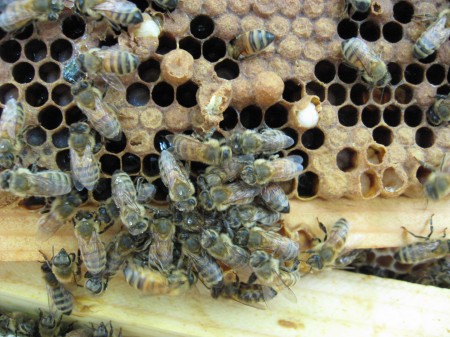
odd capped cells
pretty sure they are drone cells – they are on the top of the frame. Gave these girls a pollen patty too.
Here is a nice picture of a frame in hive #2 – nice brood pattern – few holes and surrounded by honey and a little pollen (the light or yellow colored cells)

good frame
May 25, 2014 visited hive #1 to replace queen. COULD NOT FIND HER. And more distressing was evidence of odd looking things in the hive – lots of bees though. I think some of the odd looking things were drone cells Dang! Forgot the camera again – should have known there would be good photos that we could use to consult experts – memo to self: add camera to every trip to the hives.
Some of the odd things looked like this and I think are drone cells

drone cells
Photo from the web – but our looked like this “Drone cells are larger in diameter, the cappings more rounded or bullet-shaped.” Drones are from unfertilized eggs and it figures you might see more of them if the queen is getting low on sperm —- ??
Then there were some odd cup looking things that I wondered if they were empty queen cells – but maybe queen cups waiting eggs – or eggs in them??
From the web: Supersedure cells are generally built on the face of the comb while swarm cells are usually placed along the bottom edge of the comb. (our odd cups were on the face of the comb – or towards the bottom, but not shaped like a peanut) Additional info from web: A cell hanging off the middle of the frame somewhere is usually a supersedure or “emergency” queen cell. A cell hanging off the bottom of a frame is usually a swarm cell.
Thanks to Max xx for this great photo of a queen cup.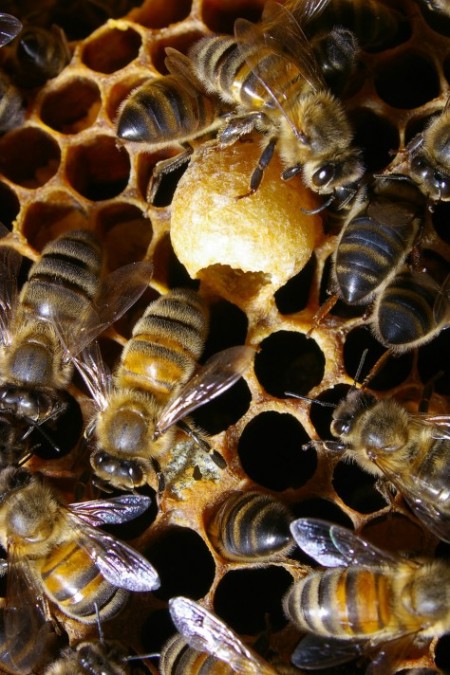
May 24, 2014 Bob made a trip up to Jim at Nature’s Nectar to get a queen. Tomorrow we will open hive #1 find the queen and assassinate her.. Poor dear, she has been working hard for nearly two years, but is at the end of her life of eggs and sperm stored in her body from her one mating flight.
May 20, 2014 Brian and Jody across the street reported signs of a bear in their yard this week!!! Yikes. But no sign of him/her near the hives, so one wonders. But I panicked the local bee community by posting it on the forum and when we went to the Bee Club meeting last night, right away they wanted a report. I said, “Well, we did not actually see the bear, but my neighbor swears there was one in his yard – took down two large bird feeders, bent them over.” So, now, who knows, hopefully it can be downgraded to a “rumor” rather than a “sighting.”
Today Bob and I visited both hives.
Lots of bees in Hive #2 in the woods – the new package – they did not need syrup, and to give them more room we added another deep super on top. We put one of the frames from the hive — swapping it out with one in the new 2nd box and then installed the second deep super on top of the original hive. Added a grease patty for tracheal mites. They did not need a pollen patty either – lots of bees going into the hive with big packets of bright yellow pollen on their legs – probably dandelion. They were docile – buzzed around but did not sound angry – it is funny that you can really tell if they are upset.

Hive #1 – we took supplies in the wheel barrow for both of these visits – think ahead!! We did a full reversal switching the bottom with the top and leaving the middle one where it was. We were prepared to put on the Queen extruder and a honey super (smaller super) in case the hive was too crowded, but when we opened it up it seemed like they had quite a bit of space and did not need more at this point. Added syrup but did not need a pollen patty. Added a grease patty (Crisco and sugar) that treats tracheal mites.
We are somewhat worried about swarming (with our experience last year) – but with the late spring, I think they are fine for some time – may not even need to do a split for that hive.
Beekeepers like to split their overpopulated hives to make more hives and to prevent swarming – other beekeepers I am reading think that swarming is the natural thing for bees to do – we are planning to do a split that just takes one deep from the hive and sets it on a new bottom board – whichever hive has the old queen will be good and the new hive will make their own queen. Learning curve is growing with us – and we find there is no dearth of advice and most of it conflicts… so we just need to find our own way – which will be the absolute laziest (and maybe most natural) way to raise bees for honey. It seems there are some beekeepers that like to be fiddling around with them all the time and lots of admonitions to do this or that… but the bees seem to be fine most of the time on their own. We do not know why our hive #2 died over the winter – but our teacher says if there were lots of dead bees in the hive, they likely starved – there was honey in that hive, but maybe with the deep freeze, they could not get to it. If there were no bees in the hive – then you might suspect colony collapse disorder or something else – when they just leave and don’t come back.
May ?? Not sure of the date, but Bob went out and checked the hives. Added syrup to hive #2, but did not have any with him so he closed it up and came back later then got stung when he went back and opened a hive again. Once they will tolerate, but not twice in one day!
May 2, 2014 Bob checked the hives and added syrup to both. Hive number 1 was completely out. Both still had pollen patties. Weather has been very rainy and chilly in the 40s and 50s. We need to arrange better water sources for both hives- maybe the little pools like Home Depot has. I would like to make a pond with lilies and fish.
April 18, 2014 a little warmer — looked at both hives. lifted the cover of hive #2 (the new one) it does have live bees and they are almost out of syrup. Did not open hive #1, I was not suited up and they were buzzing around — need to check both for syrup and pollen patties this weekend. But both came through the cold spell — the new ones I was most worried about.
April 14, 2014 very cold. I visited both hives no activity observed – could not hear any buzzing. I hope they are OK — it is supposed to be cold for the next few days and then warming up to the 50s.
April 12, 2014 Installed a hive of carniolan – new – in the woods, now the new Hive #2. Used the old hive frames including a few frames that had honey. It makes me a little sad that there was actually a lot of honey in that hive, but they died anyway – not close to the cluster, I guess. But that was the hive that swarmed and never really came back up to speed, even though we got a bit of honey out of them. All went well. Put the package in a large super and then put about a half pail of 1:1 syrup and a pollen patty. Will move the whole bee yard into the woods in deference to our neighbors who were a little worried, but did not object to our getting a permit so we now have a permit. Can’t move the other hive until next winter.
hive #1 – still by the prairie – overwintered OK – did a partial reversal – changed the top two supers, took off the tar paper cover and took off the moisture board and the bottom board. A good bunch of bees there but not an extreme amount. Put a feeder pail on with a shallow super for feeding.
Put out the bird bath in the ornamental garden that the bees seemed to like – I will go out and put in some vanilla – to attract the bees. We need to put in a better little pond.
April 6, 2014 Bob took hive #2 apart full of dead bees – he will clean up to receive the new package coming sometime next week. Opened Hive #1 – peaceful Carniolans – good girls – they ate nearly the whole pollen patty, but had plenty of honey in the top box near the cluster. YAY. Put another patty in and closed it up Did not take off the tar paper insulation nor the moisture board nor the bottom board. Lots flying around, but we minimized the time the hive was opened – had full frames of honey available from the other hive to put in place if needed. Now question is – what next for Hive #1 with all the honey – do a reversal??? Or what – need to figure it out.
March 7, 2014 Back from a winter away – hive #2, the MN hygenics that swarmed last summer and were requeened – did not make it. Bob went out today and put a pollen patty on Hive #1 that seems fine. Ordered a package of Carniolans like hive #1 to replace the Mn Hygenics. Gentle, hardy, and did not swarm.