Can you say “overdesigned?”

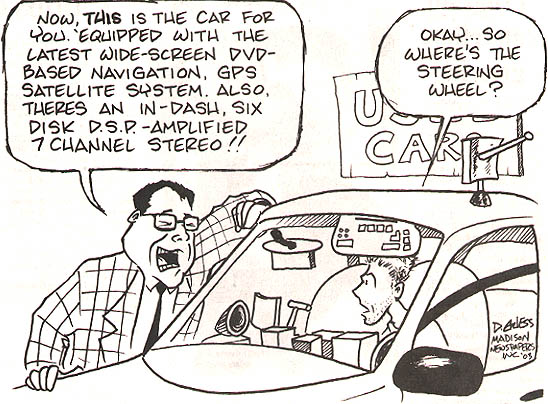
Complete with a cartoon drawn for my column by David Guess, Dells up and coming cartoonist and artist

Complete with a cartoon drawn for my column by David Guess, Dells up and coming cartoonist and artist

I recently learned a new word I love, “overdesigned.”

Consider the car. Now, I like a new car as much as anyone, but My Dad’s new SUV has so many bells and whistles sometimes it seems almost impossible to drive.

There are functions like different settings for driver one and driver two that are supposed to read which key is inserted and then automatically set the seat location for the appropriate short/tall, skinny/fat person. This means if it is programmed wrong (extremely likely unless one happens to be a computer engineer) when the key is inserted the seat behaves in such a way as it sees fit, perhaps sending you up against the steering wheel in a vise grip that nothing you can do will stop.

Another feature is the running digital commentary for various settings, streaming across a spot on the dash below the speedometer (which is thankfully still designed with an arrow that points to 30 or whatever).

My Dad got dizzy trying to fix an errant choice he made accidentally by casually grazing one of the numerous buttons on the steering wheel. Maybe they should have big warning signs on the dash, “Do not attempt to change settings while vehicle is in motion. Do not touch buttons on steering wheel unless you know what you’re doing.”

When I tried adjusting a function one time while I was driving, I was suddenly faced with running commentary in Japanese. Maybe it’s just me, but I would like to be able to tune the radio while driving without having to look, like the cars of days gone by with two knobs, volume and station choice.

I got a clue why this is happening to the things we buy listening to a public radio interview with Michael Graves who designs simple and serviceable things such as teapots and toasters. He said the technology that uses knobs for things is much more expensive to produce than using computer chips.Also more choices and functions can be added with computer chips easily and cheaply. Since competition is fierce manufacturers can add those additional bells and whistles easily to try to be better – a sad statement for our society that assumes more is better.

This is not just limited to cars, a fact obvious to anyone who received a new electronic device of some kind for Christmas such as a camera, telephone or CD player. When you get a new computer you kind of expect it will be a daunting task to figure it all out, but it doesn’t seem fair that it takes the same kind of attention to detailed instructions just to play a CD. The last CD player we got was so difficult to program that we turned it off and on with a light switch until my brother (a physicist) came to visit.

There was a movement in England in the early 1800s, the Luddites, who protested advancing technology and mass production because of jobs being eliminated. Maybe we could organize a modern version of the Luddites, protesting overdesign for health reasons, both mental and physical.

There must be some way we can get to those manufacturers to say, “KISS” (keep it simple, stupid). And while they’re at it could they please design a good cup holder and trash receptacle for a car?

Jan. 18, 2003
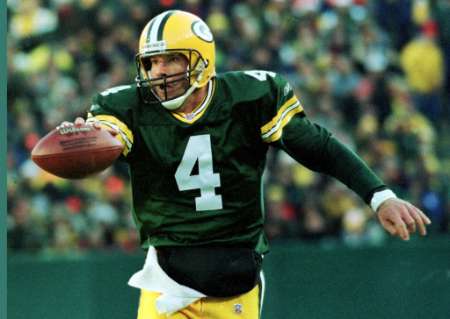
Brett Favre, Packers 2001


He is our golden boy—the laurel crowned prince. You know who I’m talking about —Brett Favre.favre

With a boyish grin he handles our collective Wisconsin “hero” projection, carrying it with ease on those broad shoulders. Even sports commentators come under his spell as they speak admiringly of his bullet passes, his accuracy, his leadership and his personality.

When the Packers played the Florida Jaguars on Monday Night football they showed some old footage of Favre as a college player, grinning into the camera from the bench. The commentators said, “He looks just the same.” And he did, same impish smile, same confidence even then. He was the fair-haired boy and still is today at age 32.

Football cynics even abstain when it comes to Favre, he seems universally admired—witness opposing team players hugs and pats at the end of each game. He is also a universally recognized icon of football, not just for Wisconsin, witness his cameo role in the irreverent film “Something About Mary.”

He lives in the collective unconsciousness of all Wisconsinites. I know a Dells woman who told me she realized, as she watched him play last Sunday, that she had dreamed about him. She didn’t go into it.

In this little central Wisconsin town the library sports a life size cardboard cutout of the star and one year they raised money selling polaroids of people with it (him). People all across Wisconsin watch television football wearing green and gold and churches plan schedules around Packer’s games

And although we love our Packers, it’s Brett that we adore. He was wild in his youth, then settled down with his marriage. We held our collective breaths when he hurt the thumb on one of those valuable hands and didn’t we all wonder if this might be the beginning of the end? But this year he is back bigger and better than ever. When he is in the groove he seems charmed, blessed by the football gods, throwing pass after pass down the field like a missile directly into the arms of receivers—often throwing across his body and on the fly without setting his feet.

I know next to nothing about football, don’t ask me about statistics, don’t expect me to know what’s going on all the time, but when Brett is on the field, I’m hypnotized. So casually does he line up and then go into gear. Nine years of starting every game, after every play he jumps up like a rookie.  Even my son, a Bears fan from Chicago, after Sunday’s game against the Packers at Lambeau said Favre is one of those players that would probably play for free, he so obviously enjoys it. Indeed, in that game toward the end it was Brett out there with a towel waving the fans into a noisy frenzy as the Bears lined up. He’s always in the game.

Years ago I taught at a school where Fran Tarkenton, the famous Vikings quarterback, sent his daughter. On parent’s night when he entered the room all the other parents were suddenly still. One colleague commented later that there were many people in that room who were much wealthier, but there is nothing to compare with pure talent.

Here in Wisconsin, harsh land of snow and cold, of midwestern angst, work ethic and pot bellies – here he carries the high ground, the best, the joy, for all of us.  Brett Favre is our showstopper, our cheesehead savior. He is our boy.

December 21, 2002, solstice

This year Christmas snuck up on me.

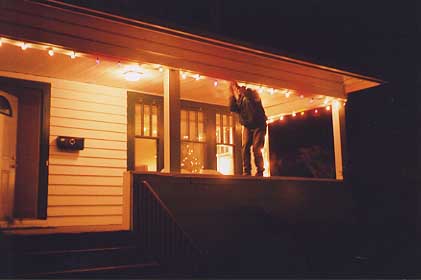
Todd puts up lights in Des Plaines

Todd puts up lights in Des Plaines

Dad and I mail many of our gifts and that was accomplished in time, but it seems like I am just getting in the mood now, and this is already my last column before the holiday.

Thanksgiving was late, I know, and then there’s no snow – no white Christmas? I’ve only been back in Wisconsin for four years, but it’s always been a white Christmas. It even rained this week, the damp balmy air feeling more like spring than Christmas.

Other things are out of whack, too. It’s hard to stay poised for war for so many months, waiting for the other shoe to drop. Since Sept 11 of last year so many things have happened Dad and I were thinking we had to check the timeline for the Afghanistan war. It seems like it happened much further in the past than just last winter.

It could be I’m just getting older. Time flies by at breakneck speed and I don’t have time to read everything I want, much less accomplish what I need to do at work and at home.

I bought some new lights for the one big tree in the yard since squirrels chewed through the old lights, leaving them in shreds. Lights are still not up as I write this – I guess I will just have to get out there at night because the big problem is so little daylight. It is already dark when I head home, and it’s even a little dim in the mornings.

I like Robert Frost’s poem, “Stopping by the woods on a snowy evening.” “The woods are lovely dark and deep, but I have promises to keep and miles to go before I sleep.”

This metaphor for mortality is poignant at this time of year. Living in the deep woods, I sometimes go out into the cold at 11 or midnight. Orion is up in the sky (my favorite constellation) with the three stars that make up his belt very visible; other stars that form his sword hang from the belt. The Pleiades, or seven sisters, is a little ways up and to his left.

According to Greek mythology, Orion, the hunter, was in love with one of the seven sisters who form the Pleiades, but she would have nothing to do with him. His life ended when he stepped on a Scorpion. The Gods felt sorry for him so they put him in the sky with his dogs, Canis Major and Canis Minor. They also put all of the animals he hunted up there near him. Scorpius, however, was placed on the opposite side of the sky so Orion would never be hurt by it again. It’s a tender story about a vulnerable warrior. One would never guess this dominant archer in the sky is there because he was pitied.

The night air is clean and cold as I look up – all is quiet. It seems everything is poised, waiting for whatever is next.
Maybe that’s what Frost was expressing in his poem. It seems so important to stop my rushing around, even for a short moment, to notice the world around me, and then go back to the fray.

Solstice is tonight, Dec. 21, at exactly 7:14 p.m. our time. It’s the longest night of the year, and metaphorically, the deepest dark before the coming of the light.

In the atmosphere of this quiet, holy time, messages from the unconscious are perhaps more available in dreams and in other ways. The veil is thinner between the knowable and the unknowable.

I know I am going to light a few candles tonight.

One personal and one public tragedy

Two Saturday’s: on one, seven astronauts died in a fiery flash across a blue sky; and on the Saturday before, my Dad died quietly, walking in the woods with his dog.

He was 84 and lived his life fully until the moment he died. Going so quickly in his beloved woods was his reward for a life of devotion to his family and to the great mystery behind life some call God.

No one loved nature more. He dedicated his energy to looking after the nation’s forests in Wisconsin, the Black Hills of South Dakota, in southern Illinois and for awhile in the head office of the Forest Service in Washington, D.C.

It is a particular piece of learning to have a public and private tragedy so close together. My brother said of the national tragedy, as we were all still reeling and sorting out details of Dad’s passing, “I feel sorry for them, but in the midst of a personal tragedy …”

I know what he meant. When someone dies whom you have loved very much, no matter how prepared or unprepared you are, the body and the mind go into shock. Food is tasteless, concentration is nil, floods of tears alternate with a zombie-like feeling. There is little energy for tasks that must be done and even less for sensitivity to someone else’s tragedy.

Our family has always had a great sense of humor and I have to say, the times I felt most normal were when we were laughing together. I recalled all the times I used to entertain Dad with funny little episodes of my work life at the paper (many of which did not make it into print). Still, grief takes over for most of the time. It is shock that we will not all live forever, silly as that sounds.

Others grieving on television was a jarring sight; placing the flowers, talking about those gone, the survivors holding each other, and the resolve to continue the mission of those who were lost.

It was validation of my own grief to see it, the whole nation grieving for seven shining stars, while our smaller circle grieves for our own shining star.

His mission will also go on.


Feb. 8, 2003

Prayers for Peace

Some of us who were adults during Viet Nam have been troubled by the drum beating going on these days. We remember all too well how the numbers of dead kept adding up with little progress in the fuzzy justifications
for the war which ended with us giving in.

The Viet Nam Memorial in Washington is really a fitting statement about that war. The huge black wall is a timeline
starting as a small granite sliver coming out of the ground with names of a few dead, and then more names and more
until it fills a huge wall with Americans who died. It then continues to slope down until the numbers trail off and it
was truly over.

No one wants that again.

Can we trust those public servants we’ve elected today to make the right decisions? We couldn’t then. Mistrust runs deep for many of us after experiencing Viet Nam. My parent’s generation have the history of World War II when war was clearly justified.

So far (knock on wood) it seems the sword rattling has accomplished something in pressuring Iraq to cooperate with U.N. inspectors.

I admire Colin Powell, a forceful diplomat and, obviously, a kind and principled person. I don’t really like George Bush.

War should always be a last resort. I can say that with certainty, but I know there is so much I don’t know, and forming an opinion of what should be done really feels beyond my scope.

For example I read a compelling piece in the January issue of “The Progressive” written by one of the “estimated 3.5 million Iraqis in exile, mostly intellectuals and professionals from the left, liberal or Kurdish nationalist currents.”
Faleh R. Jabar writes about a Saddam Hussein who admired Hitler’s system of government and makes a good case for us to help overthrow that regime. He does offer an alternative to war.

“Threaten Saddam with indictment, give him an alternative for safe passage,” writes Jabar. Then create a list of thirty or so of his aides who also must go, convincing the rest to clean house. He says this should be followed by a “mini-Marshall Plan” provided a civilian government was organized. He adds a few “warning shots” may be necessary.

I was heartened to hear Powell on the news proposing something quite similar, and the whisperings of a palace coup are also encouraging.

But, in all, it feels way beyond me to decide what we should do, so a few friends and I are getting together today, Saturday, at noon in Bowman Park to hold a vigil for peace. Everyone is welcome to join us.

There is one thing that I do know for sure – there is power in prayer. We can pray for the most peaceful solution to the problem without having to prescribe how that happens

Feb. 15, 2003

prayers for peace in Bowman park

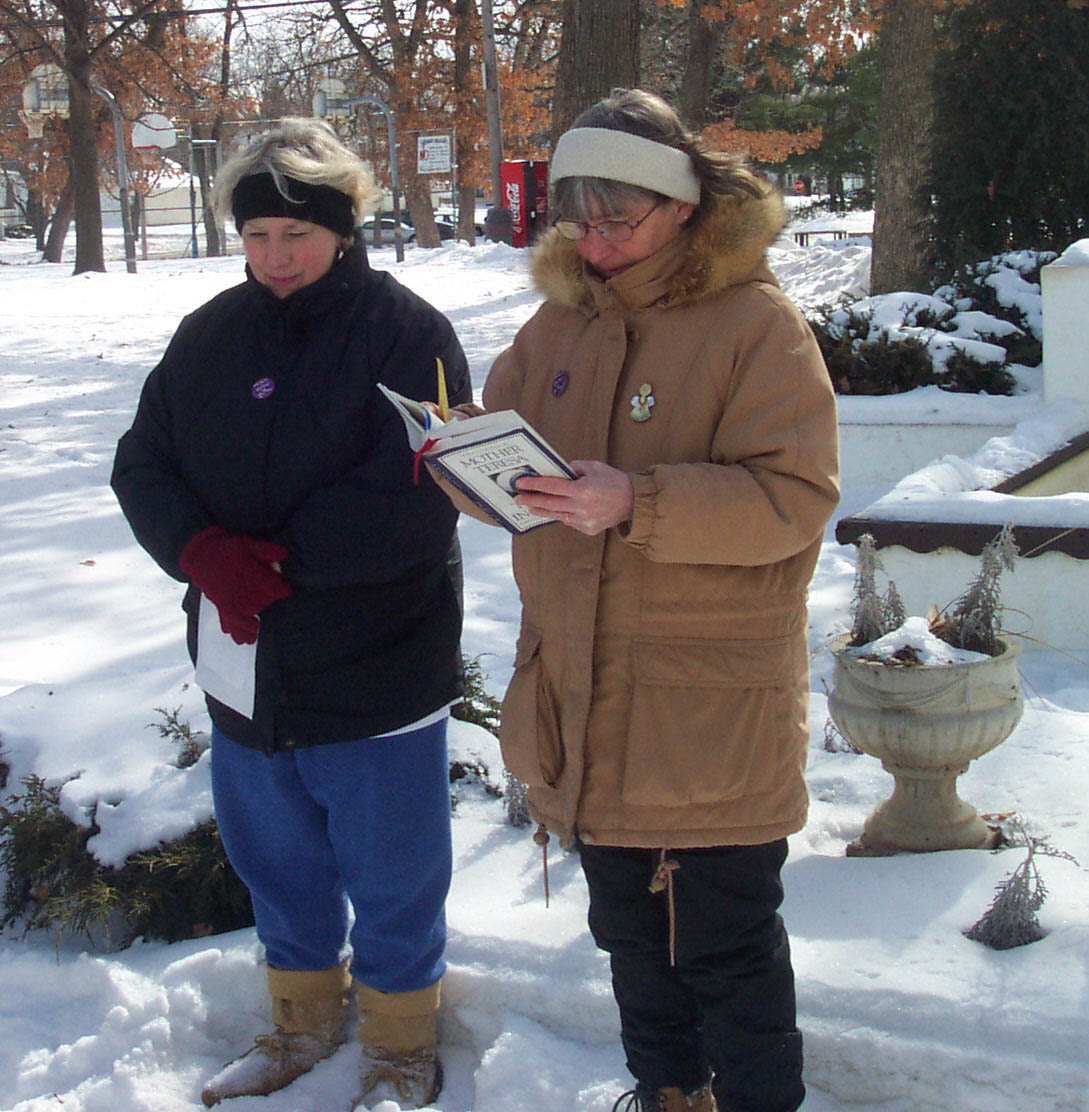
30 people showed up to pray for peace in Wisconsin Dells on February 15, 2003.


Judy and Pearl at the peace rally

Judy and Pearl at the peace rally

Peace Movement, 2003

Something interesting has happened with the peace movement since the angry days of Viet Nam.

When documentary filmmaker Michael Moore ranted at Pres. Bush at the Academy Awards last Sunday he sounded out of line and outdated. Other stars, unlike Moore, made calm statements in support of peace and were applauded; Moore was booed.

I have been reading all I can get my hands on about how to react to the war without “dissing” the soldiers sent to fight (as Molly Ivins said in a recent “Progressive” column).

The sense I’m getting is the impulse to turn away from becoming strident and angry, but instead focus on “peace,” to hope the war is over as soon as possible. Pretty much everybody can get behind that and there are some good suggestions around on how to support that concept.

A recent “Utne” article is titled, “Make protests fun: 1-2-3-4, we don’t want shrill chants no more.” It quotes Mark Sommer, director of the Mainstream Media Project in California, “To be driven by fear and anger more than hope and determination is to catch the very illness we seek to combat.”

Sommer advocates mass demonstrations that include music, dancing and mass silence, “Everyone has a different version of how they find the deepest part of themselves. Whatever you call it-praying, meditating-to stop and listen to what can be heard when thousands of people stand in silence is transforming.”

Madison’s Buddhist community is holding regular walking meditations in support of peace and last Sunday’s “Parade” magazine’s lead article was, “Can prayer really heal?” Scientists are finding that prayer and faith have been shown to speed recovery from depression, alcoholism, hip surgery, drug addiction, stroke, rheumatoid arthritis, heart attacks and bypass surgery.

It looks like praying for those in trouble really helps them as well as making us all feel better for doing it. Why not apply this to the painful world situation?

In the “Parade” article they asked Rabbi Harold S. Kushner, author of “When Bad Things Happen To Good People,” to compose a prayer for our troubled world that can be said by anyone of any faith. It reads, in part:

Let the warmth and brightness of the sun melt our selfishness
So that we can share the joys and feel the sorrows of our neighbors.
And let the light of the sun be so strong that we
will see all people as our neighbors

I have participated in two “peace” demonstrations this winter and both times the easy, natural thing seemed to be to stand and pray in silence. The candlelight vigil in Baraboo was most powerful when everyone stood silent in a circle, each holding his or her own dim, wavering flame.

Here is a Peace Rose….

the peace rose

Thanksgiving in the Dells

The family that started with Delbert and Judith Landt who farmed in Newport beginning in the 1890s, held reunions twice a year – on the Fourth of July and Thanksgiving.

When Marjory Lapp, the last of the generation of Delbert and Judith’s seven children, died several years ago, the family discontinued the Thanksgiving get-togethers, but still gather every year on the Fourth. This July about 40 or 50 people were there.

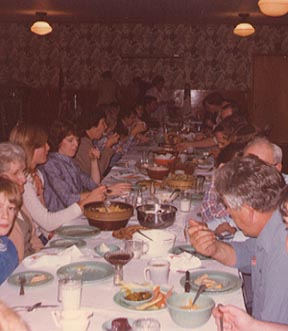
I remember the Thanksgiving feasts from my own childhood that were so big the family had to move to the 4-H building in Newport, now the town hall, because no one’s house could accommodate the crowd of relatives and friends.

Thanksgiving 1976

Thanksgiving 1976

My father remembers Thanksgiving on the farm. “There was always room for more,” he said fondly this week as he recalled the huge gatherings. It’s wonderful to be part of a family that acts like a Norman Rockwell painting looks – huge meals, every woman outdoing her cousins and sisters with the cooking, and with big eaters being appreciated too. Dad said everybody knew
that Janet’s boys (Richard and Leonard Holt) could really go through the potatoes.

We usually had three turkeys and the food filled the long tables to groaning. Dinner rolls were made from scratch, as was everything else. Nobody worried about cholesterol or watching the figure; food was there to be enjoyed and shared.

Loris Harrison, Rena Landt Palmer’s daughter and my Dad’s cousin, told me that one year she had gone away to school at Stout and “I got orders from headquarters to be home for Thanksgiving since it might be Grandma’s (Judith’s) last Thanksgiving.” Judith had moved into town after Bert’s death with her three youngest girls.

Loris recalls the difficult trip coming into the Dells in the middle of a big snowstorm that was so bad her parents barely made it into town from their farm for Thanksgiving. Also, she adds, Grandma lived for quite a few more Thanksgivings, long enough for Loris to be married and with a child of her own.

I loved bringing my own family back to the Dells for Thanksgiving. If I had been away for awhile out of the loop, I was hard put to name all the relatives for my children, but my mother, who married into the Landt family, kept them all straight and helped us out.

The tradition was wonderful; but the best things were the values learned at those tables. Generosity, abundance, inclusiveness, love and thankfulness all come with us wherever we go. The years I didn’t come back to the Dells, I made Thanksgiving dinners for my family and friends with the same care and abundance.

The memories also remind me of how important stories are in families. One way we learn how to be a family is by the stories we are told about our ancestors. I can’t resist telling one of my favorites because it illustrates the open hearts of my ancestors.

Another member of Judith and Delbert’s family was Dan O’Neil. Dan was left an orphan, along with his older siblings, after diphtheria epidemic. His older sisters went with some aunts in Milwaukee and the older boys went to farms who could use them for work.

“Bert” was still a young man when he went to the O’Neil farm auction. He could see that Dan, a little frail boy of only six, seemed unwanted. Bert just took Dan home with him without asking his parents if they wanted another family member. When Delbert married Judith, Dan came along as a part of their family.

Dan later became a pharmacist in town.

I haven’t always had this appreciation of my heritage. For many years as a young person I took it for granted, and there were a few years I spent in rebellion. I also know no family is perfect, and dysfunctional families can have awful holidays that seem to bring out the worst in its members. Alcohol added to a mix of old grudges can cause new heartaches.

I have often counseled therapy clients to begin their own traditions when they don’t like the ones they inherited. It’s a good idea for everyone to take what is good from one’s family and leave the rest.

And it’s never too late to start a tradition.

A week in Mexico – 2003

OK, I’ll admit it, I left the cold tundra for the warm tropical breezes of Mexico last week, like so many other “snowbirds” from Wisconsin, Minnesota and other parts north.

I played hooky from work at the paper and flew, with an old friend, from Minneapolis to the Yucatan. We participated in “ecotourism” which meant sleeping in a tent covered by a palapa (the palm roof that keeps things cool), no electricity and communal bathrooms and showers.

We were back to summer camp, but as adults this time. We spent time swinging in a hammock while reading and occasionally looking out toward Cozumel Island where the cruise ships steamed away. Other daily activities consisted of lots of “corpse pose” yoga (flat on the back, hands at the side).

Also there were no organized activities, no cheerful camp counselor to make us get up and do something and no “Kumbaya” in the dining room.

My companion for the trip admitted she felt about nine years old, the age she took a snake to school for show and tell. The boy she was trying to impress promptly fainted at the sight.

The days filled themselves easily and after sleeping for up to 12 hours a night for three days plus naps I was finally rested enough to walk on the beach and loll around by the pool at the resort next door. Electricity and amenities were plentiful there and we were invited to share.

I understand this exhaustion is typical of grief. This break came at a perfect time for me, a few weeks following Dad’s death, although the trip had been planned for some time. I left my older brother and his wife here at the house looking after estate matters, and escaped the cold and reminders of sorrow.

Grief never quite left, but even that was good – time to think and remember uninterrupted. Feelings come in waves, I used to tell my therapy clients, and it is best to allow them to crest and fall, rather than attempt to stop them.

Waves relentlessly crashed on the Yucatan beach, steady and never ending. Close by were ancient Mayan ruins, reminders of time and change.

I returned home on Dad’s birthday. He would have been 85.

In the end, I remembered Dad’s words after my mother died. He loved her dearly and missed her terribly, I know. But he said, “I can be sad the rest of my life, or I can be happy. I choose to be happy.”

Me, too.

March 8, 2003

Hope 2003

The cover of this week’s “Time” magazine is covered in duct tape, and dread and fear make up the news as our young people are deployed to the Middle East.

Not an encouraging time, one might say, and yet I feel encouraged on this spring-like day in February. It really looks as if there may be an end to winter sometime in the future, millions across the globe said yes to peace, and, to top that, I found out my daughter and her husband are having a baby.

These are normal events – my father dies and in the next breath a new one will be born, God willing. I always add this, like my Egyptian friends who say “in shalla” or God willing, after almost everything including dinner plans.

It is a challenge to hold onto hope, overcoming the pull to despair, but the signs are all around.
On my morning walk to the big white pine, where both my parent’s remains now rest, I see deer tracks that appear to originate from the spot where their ashes are buried.

It looks like a doe and her young one. I spot the distinctive two pronged tracks in my path as I walk through the woods, following them back to the base of the tree. I look up through the branches of the towering pine, and then out to where so many younger trees are sprouting in various stages of growth.

When my mother died several years ago, and we were all gathered at the tree, Dad pointed out the thick woods full of pines, all seeded from the big one with most of them springing up to the east of the tree, “sent by the prevailing winds.”

So we now await the birth of a new family member, welcomed with such love and hope. I think it is the highest expression of hope to have a child in these difficult times.

The prevailing winds, I have to believe, will still bring love and hope and peace, God willing.
We are poised on the verge of war, but so far, as I write this, we are not at war. There were millions of people last week who said they are hoping for a peaceful solution to a thorny problem. War is a failure, violence is always a failure.

When I worked with abusive families in New Mexico, we tried to help those men and women realize that when they struck out violently in anger it was a sign of their helplessness, their impotence, of their inability to peacefully solve their thorny problems. Talking is better than hitting.

I do not ignore the reality that there are people in this world who have no conscience, no morality, or a such a twisted morality that it allows them to hurt others. We need our police and jails; we need defense.

But I am heartened that President Bush has appeared to have taken the advice we always gave those parents to take a deep breath and count to ten before doing something one might regret. I have to believe we can still reach a peaceful solution, God willing.


Feb. 3, 2003

Soccer Mom

For a few hours last Sunday I was a soccer mom again.

My son, at age 38, still plays in a couple of leagues in the Chicago area and his girlfriend and I sat on the sidelines to watch and cheer just like in high school.

Todd and Ann Marie at the game

Todd and Ann Marie at the game

It has got to be one of the most pleasurable activities of a parent – to watch our children as they try hard at whatever it is they love doing.

I am a great fan of team sports, in fact any sport or activity for kids. There is nothing like the camaraderie,learning what it means to be a part of a team, dealing with those of more and less talent and the experience of success … or failure.

Children not interested in sports might be drawn to some other activity. Even those computer “addicts” should be encouraged (within reason)-that’s how Bill Gates started out.

When I was in high school, theater was my thing. In this community I see 4-H capturing the passion of rural children who raise animals and perfect their skills. The Dells is also well known for its excellent band and music programs.

Whatever the activity is, we do our children a big favor by encouraging their exploration and commitment to something. Supporting a child’s activity also means a big commitment on the part of parent- volunteering to coach, raise money and, needless to say, hours spent behind the wheel as a chauffeur.

Sometimes it takes a lot of experimentation to find a niche. Both of my children tried instrumental music in grade school, as did I as a child-it didn’t stick for us.

There is nothing like the commitment to a cause, activity or team to be a positive influence in a child’s life – drug prevention people call this the “anti-drug.” It is normal for teenagers to seek the adrenaline rush and emotional experience. If they don’t find a healthy way to get it, unhealthy ways are very tempting.

I remember well my son’s senior year in high school. He had been co-captain of the soccer team for two years and they lost what was their last game, eliminating the team from advancing to the next round. As he walked away from the field after the game he was crying. I know it was not about losing, it was just about never playing with those friends again.

As I watched him last weekend, twenty years later, I saw the same camaraderie, the same laughter, the effort, and occasional bursts of frustration.

When I was in Mexico on vacation this winter I had a great time watching a number of young Mayan men play soccer (or futbol as they say) on the beach after their workday was done. As the sun moved lower in the sky, casting a gold glow over the scene, there they were in bare feet, with a soccer ball — palm trees and piles of sand for goals.

It was the same – the grandstander, the quiet, solid player, the bossy one, the one who struggles – the joy. It must be universal.

My daughter spent years in gymnastics and credits her poise today to the control over her body she needed for that sport. “You really have to be centered,” she told me once.

I recently watched some super-8 movies we took almost 30 years ago of their early sports activities. My daughter was in T-ball and her brother, three years older, was a pitcher on a baseball team. It brought tears to my eyes.

I notice the local park and rec. department is looking for more volunteer coaches and I encourage everyone to sign up. These opportunities for children would not available without parental participation.

I could coin a phrase and say, “(Almost) everything I needed to know to be a parent, I learned being a soccer mom.”

May 3, 2003