Connections…ecopsychology

Spring brings out the reproductive urge in the woods where I live. Squirrels, song birds, turkeys and even snakes are actively on the move.

I recently learned that it’s the juicy conditions for nesting in this north country that is the reason birds learned to migrate. I also notice humans turning “to thoughts of love” and trees and gardens sprouting new growth.
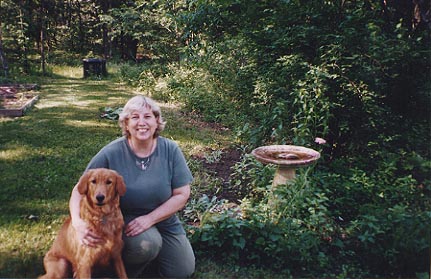
Judy_rosie__garden__june_01


All this made it doubly awful when I had to finish off a mama squirrel mortally wounded by our adolescent golden retriever. Rosie did a good job of catching the squirrel, but a bad job of killing her. I can’t blame the dog who was just being a dog; but that left the human responsible, me, with the dilemma of what to do with a mortally wounded squirrel, obviously a mother.

I did, with tears in my eyes, quickly kill and bury her.

My heart was broken and stayed broken for several days. I told myself the tiny squirrels venturing out of the woods the next day were her babies, but I’m rationalizing.

I hate seeing any creature hurt and dying. I have reconciled myself to deer hunters in our woods since I know without them an overpopulated deer herd would starve, sicken and die. Chronic wasting disease may have gotten an easier foothold because of a weakened, overpopulated deer herd.

The balance of nature is fragile but inevitable. Take the squirrels; a couple of years ago we were so overrun with squirrels I had counted 24 at one time. Then we had a winter with three feet of snow cover throughout the woods for months. Squirrels must have starved in scores because the next spring there were only about three or four.

Last summer the squirrels recovered and, although we are not up to the high numbers, we are seeing a lot of pretty healthy looking squirrels at the feeders again, outsmarting all efforts to keep them away. One squirrel learned to jump from the gas tank to the pedestal feeder.

So why shed a tear for one?

It’s the difference between the big picture and the little picture, the global versus the personal. “Think globally act locally,” say the new ecologists.

Ecopsychology or deep ecology is a new field, a development in the continuum of first understanding our psyche as a self-contained unit to expanding the sphere of influence to include families. Family systems theory maintains an individual is greatly influenced by his or her surrounding family, and the family tends to maintain an equilibrium. This accounts for the puzzling phenomena of one person in a family recovering from alcoholism, say, only to have another family member become ill or problematic in some way.

The next progression, say the ecopsychologists, is that we also cannot separate ourselves from the world around us — we are a part of the total ecosystem.  I am to the point now that I can’t throw a glass container in the trash without making the extra effort to find a place to recycle it.

My wildlife conservationist daughter is a source of inspiration. She forced her sorority at UW-Madison in the late 80s to develop a recycling program before it was mandated. She and her husband are also an example of low impact living — driving an old Honda Civic and eating few processed foods.

But I like my SUV, fast food and the conveniences of modern life. Like many people I know I would probably balk at preservation measures that inconvenienced me.

We have not been very good caretakers of our home here on this planet, seeing it mostly as a place for our use and pleasure. I am grateful to that mama squirrel who reminded me that life is short, fragile and very precious, and I am not so very far away from her.


May 25, 2002
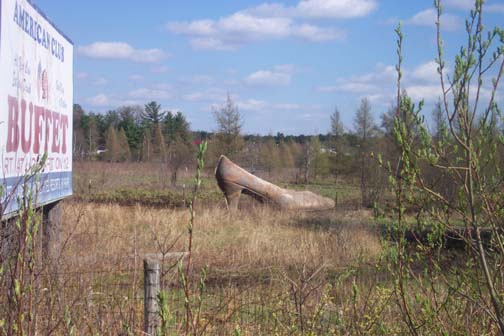
The Shoe Mystery

We got a tip here at the paper from one of the librarians who was wondering what was the story with the big shoe barely visible on Trout Road. The editor asked me to get a photo and we questioned our resident Dells history expert, Janice Luete, what her guess was about the big shoe.

“I think that used to be Mattei’s land — maybe Storybook Island?” .. The old woman who lived in a shoe most likely … that was the guess.

shoeAll communities have these local mysteries and questions we ponder as we drive from point A to point B. Another one is the wayside on Highway 13 before you get to County K. Anyone who drives past this spot has watched the evolution of the DNR or Park Service or whoever is in charge versus whoever it is that fills the garbage cans up with excess junk.

Many times the place would be overflowing with trash – not just ordinary garbage either; but appliances, carpets and old machines. The government would be there loading it into garbage trucks, the site would stay clean for less than a week and then filled up again.

The next tactic was to add additional garbage cans. That didn’t help. Then there was a period of time when a full sized dumpster was on the spot – also overflowing with trash. When even that didn’t prevent overloads of trash, they took all the garbage cans away and put up signs saying, “No garbage collection, take your trash with you.” Fat chance. People left trash where the garbage cans used to be.

The next tactic was to close the wayside entirely, enforced by adding large cement median – type blocks at the entrances. The last addition is a snow fence on the outside of the wayside. It’s hard to see back there now to know if anyone is still storming the obstacles to leave trash at the site.

Since we are in the news business and one of our functions is to get answers for community mysteries, I called Treasure Island Resort and a woman there said our guess on the big shoe was a little off.

“It’s left over from Emerald City,” she said. “That was there even before Krazy King Ludwig’s that’s now Big Chief – it was there when I was about ten years old.”

Following up on the wayside mystery, a call to Dells Forest Ranger Gary Bibow yielded some results. He said Adams County Highway Department is in charge of the wayside and the site is one of 18 being closed across the state. He said he thought the garbage problem was one of the factors in deciding to close that one. I was not able to reach Ron Chamberlain, Adams County Highway Commissioner, who would probably have given me an earful.

“They’ve tried everything,” said Bibow, “even having the sheriff’s department wait to see who was dumping and then citing them for littering. But they found if people didn’t dump it there they would just go down the road and throw it in a ditch somewhere.“It’s been a problem,” he added in the understatement of the year.

Bibow said he had even heard livestock had been left at the site. I said I wouldn’t doubt it.

When I lived in Santa Fe New Mexico we had a community shoe mystery. A stretch of road, within the city limits, every once in a while would be littered with shoes – all kinds of shoes; ladies, men’s, sneakers, kid’s shoes – usually in pairs. This went on for years.

The shoes would get cleaned up and then a few weeks later when I drove by there would be more shoes in the road. No one, that I know of, ever came forward. It was never learned why – why shoes, why there?

Any other mysteries out there for us to solve? Send them in.


April 27, 2002

Searching for answers in the past

Where is it possible to find a whole bunch of people exactly one’s own age? A high school reunion, that’s where.

I don’t know what sends me back to these gatherings every ten years, but at this one, my 40th, I took a more proactive role organizing a “nostalgia room” that turned into a nostalgia corner. I took my old scrapbook of mementos and photos and asked other classmates to bring theirs. My sister-in-law, who was in my class, had all the yearbooks and we ran “Breakfast at Tiffany’s” on a VCR to remind us of that era.

I think I was looking for my old self, the one I started with so many years ago, when everything was ahead and possibilities were unlimited. There is something about the age I am now, my late 50s, that needs a little of that optimism. This is a time in my life where everything I wanted to do has been done. I’ve had a family, I have loved, I’ve had a successful career (or two or three), I’ve traveled and lived in diverse places and made so many good friends in all those places I can’t keep up with them.

I was curious if any of my old classmates were also at this crossroads, for that is what it feels like. It seems like there are some choices here– to rest on one’s laurels or to set a new course of some kind.

When I was in my 30s and 40s I always had a plan “B,” what I would do if what was presently going on fell apart. Sometimes I even had a plan “C” and “D.” One of my plans was to join the Peace Corps. I still keep this as a possibility, especially after ex-president Jimmy Carter’s mother set the example by joining the Peace Corps at an advanced age.

Maybe this is a hint about what this stage in life is about—a quest for meaning.

As I spoke with classmates at the reunion, I was most interested in those who are pursuing spiritual lives. The somewhat shy and sweet boy I talked into asking me to the junior prom (since I had broken up with a boyfriend) was now a Methodist minister. And a bright and funny high school girlfriend had gone to Harvard Divinity School within the last 10 years and was now a Unitarian minister. This fascinated me, although as I talked to her I realized her life had just as many issues and problems as my own. Most of the people were beyond bragging about careers, money and children.

I always wonder what brings people back – and what about the ones who don’t come back? I loved some of the stories about them. One boy who had hung out with our group was now a fly-fishing guide in Washington state and had been for years. I wish I could have talked to him.

And then there are those who will never be coming back. There is nothing more chilling than seeing a list of classmates who died. The hardworking people who organized my reunion took advantage of the quick communication of the internet to track down people and at the same time pull together a list of those who died, including, when it was known, the cause. Most died from heart attacks and cancer, one murder, some unusual diseases and many unknown.

When I drove away from the town in South Dakota where I went to high school I knew there would be those who wouldn’t make it back next time. Who would they be, I wondered? And it is a possibility, of course, that one of them could be me.

There’s the rub.

And from it comes a motivation to really live during the time I have left. No time anymore for nonsense fears and doubts. Full speed ahead with plan “A” (whatever that is).

Maybe a re-acquaintance from the reunion said it best in an e-mail to me: “Just keep going, hope for the best and expect the worst. Except as relates to my kids, there are no emergencies in my life and I hate it when others think there are. Main thing is not to panic over anything, which leaves you in a good position to get through most anything, except, that is, if your time is up.”

A good philosophy, I think, even when one’s time is up.


August 3, 2002

Truth and Lies

I’ve been pondering the subject of honesty lately with the eroding of trust of just about everything. Big corporations and the accounting firms that are supposed to be their watchdogs are in focus now.

On a trip back from California a few weeks ago the airplane was full of people traveling to Chicago for a candy convention. Seated next to me was an attractive, slim California-type woman who engaged in lively and friendly conversation with the rather plain but pleasant man on the other side of her. It was difficult not to eavesdrop and I found out she was a food broker, a sort of middle man/woman between the manufacturers and the distributors.

At one point I made a little conversation starter thinking she seemed interesting. Her attitude towards me was cool at best and dismissive. She did reluctantly answer a couple of questions, but I stopped trying to engage her since it was clear she did not want to chat with me. That’s fine, I thought. Many people want to be left alone while flying.

But her attitude towards me was in such sharp contrast to her attitude towards the young man, that I found myself trying to figure out their relationship, busybody that I am. I noticed he wore a wedding band and talked about his family. He mentioned his father, also on the plane, and a few more things about his business.

I realized he was one of her customers. At the risk of being VERY catty, I think she was buttering him up for that reason. Now, maybe this is all conjecture, maybe I just got my feelings hurt because she didn¹t want to talk to me. But even so, it is hard to think there are actually people in this world so calculating. I know there are, whether my seatmate was in this category or not, I’ll never know. In the words of an anonymous quote on the internet, “If someone is nice to you but rude to the waiter, he is not a nice person.”

It always shocks me that someone can be dishonest, even look me straight in the eye, and lie. I know I have lived a sheltered life and there are many people who have to learn to detect lies as part of their survival skills, like learning to balance a checkbook.

I am thankful I grew up in a family and society where mostly I can count on people to give me a straight story. Even as a reporter, I find people willing to tell me all sorts of their own personal truths and I sometimes sort through the data and double check what they want to say.

Now, there are times when probably all of us tell a fib, to save someone’s feelings, for example, or avoid a consequence. No one is perfect, and a blunt truth teller can be abrasive. But another thing could have been operating with my seatmate, the curious psychological phenomena — projection. If I have a trait I hate I can “project” it onto someone else and then hate it in him or her. The colloquial saying for this is: When you point a finger there are three pointing back at you.

Many spiritual paths talk about how our enemies are our best teachers. This “pushing my button” feeling can be a pretty good indicator that I have something to look at in myself. Am I capable of her kind of manipulation? Probably.

Telling the absolute truth is often hard. Although a difficult truth told in a spirit of caring can create greater intimacy with someone we love. I was often witness to this in family therapy sessions.

Another thing happened on that same flight with those candy people. I had my
driver’s license out for identification and one man read it over my shoulder. He asked me where in Wisconsin I was from and when I said Wisconsin Dells he said, “Holiday Wholesale.” (One of the local distributors.)

I laughed and said, “Yes, Bud Gussel.” (Bud started Holiday Wholesale.)

The man looked at me and said, “You know, Bud Gussel is the only person I know who puts his home phone number on his business card.”

I said with assurance and a grin, “That’s Bud.”

In this complicated world it’s not always easy to tell the good guys from the bad, truth from lies. Shades of gray are more the rule, but once in a while, along comes a shining example.


July 6, 2002

Scary Critters in the Woods

There are some pretty scary critters in the Wisconsin woods these days.

A few weeks ago the dog scared up a snake that looked like a cobra. It hissed and raised up and spread out the sides of its neck. A careful look reassured me there were no rattles on the tail and I was positive cobras do not inhabit the wilds of Wisconsin. Of course, there’s always the possibility it could have escaped from somewhere like that ‘gator the other day. (A found alligator was reported on in the Events earlier)

I guess many animals take on characteristics of their more lethal cousins as a protection. But one wonders how this snake knew we’d all seen those flute playing snake charming pictures from India. We carefully helped the visitor into a bucket and relocated him.

We haven’t had a snapping turtle sighting lately. Occasionally we’d spot him surfacing in the middle of the pond. We don’t swim in the pond anymore – too scary. My uncle confronted him on a path a few years ago. By his account the thing was huge, prehistoric looking and didn’t stand down an inch.

But, by far, the scariest of all of critters in the woods is the lowly tick. Every year we say, “bad year for ticks because of …  mild winter, late winter, wet spring…” With the threat of Lyme disease the discovery of a tick somewhere on the body sends us to visions of bubonic plague, or the specter of a long, unidentifiable and incurable illness. No matter that the disease can be treated fairly easily once diagnosed with antibiotics. And also never mind that ticks that give us and our animals Lyme disease are not the ones we are horrified to find attached to our scalp under the hair like a little scab.

The Lyme disease ticks are only a little bigger than the period at the end of this sentence. I know, because I’ve seen ones they have on display at the Baraboo hospital urgent care clinic.

I have many memories of scary ticks. When I was about ten or eleven I got a tick imbedded on my thigh. These were the days when the recommended treatment was to burn the little thing until it “backed out” of the skin. I guess I screamed and had quite a fit, I’ve repressed most of the ordeal.

Now, when I find a tick on my dog or even (shudder) on me, I get a good hold of it down by the head and yank. If a little skin comes off with it so much the better, that means you didn’t leave any parts imbedded (dire, un-nameable consequences – leaving something imbedded).

They are found much more often on the dog than on people and if they are not removed right away they can swell up to the size of a grape. Yuck.

This information is all in the category of “family tick lore” so I thought I better get some more “official” information for this story. Consulting the internet only increased my tick paranoia since now I know it is also possible to get Rocky Mountain Spotted Fever from a wood tick and also Colorado Tick Fever. But there was nothing about these diseases in Wisconsin; only Colorado, Washington, Idaho and Montana.

I was glad to find that my method of grasping the tick near the place it is imbedded and pulling it out is recommended, although one site said the tick would disengage. I don’t want to wait even a millisecond for the thing to disengage.

Most sites also recommended insect repellent to discourage ticks and tucking socks in pantlegs while walking in tall grass or wooded areas. The University of Wisconsin Urban Horticulture website (http://www.uwex.edu/ces/wihort/pests/DeerTicks.htm) says it takes a deer tick (one of those small ones) 24 or 48 hours of feeding before they can transmit Lyme disease – that’s some comfort.

“Tick checks, everybody.”

June 24, 2002

Addendum, September 6,2009  As I transfer my dated Family Times columns to my new website, I found this one, written in a lighthearted manner. It is very ironic since at some point during my life in the Dells I did contract Lyme disease. It wasn’t diagnosed at that time — no bulls eye rash that would have alerted me.

It was finally diagnosed years later after my move to Minnesota by a very persistent MD who ruled out lots of things before ordering an extensive test for Lyme. I am now on the mend and feeling stronger, but it has taken nearly a year of treatment with various antibiotics and supplements. The warning in this column is real.

The precious present moment

On every trip I’ve taken after Sept. 11 I am reminded, by the extra security precautions, that things have changed.

On a recent flight to California to see my daughter and her husband, I had to show my “photo ID” five, count ’em, five times, before I stepped foot on the airplane. Maybe it’s Sept. 11 or maybe it’s just the age I am; but it is more and more obvious to me there is no safety in the world, even if I wear my seatbelt, eat a low fat diet and have an annual physical.

The truth is at any time any one of us could die in a horrible, painful way. Out of the blue, out of left field, something could happen. We know intellectually our death is waiting out there for us someday, but the feeling sense of that, perhaps for the best, eludes us.

Not only the finality of death, but the future of me as the person I know myself to be, can change in an instant or through a long process – auto accidents and  illness for example. There are no guarantees in life and no reward for being good. There is nothing we can do to insure the safety, health, life and happiness of ourselves or of those we love. Common sense tells us to do as many things as possible to keep us healthy and happy, but the end comes for all someday.

What, then, is there to do? Live it up as if every moment is the last or just go on with life as if nothing has changed? Hedonism and denial – neither seem like a good alternative to me. I am looking for some advantage, something positive in having this veil of illusion lifted.

“Be Here Now” said Ram Dass in the 60s, maybe it’s even more relevant now. I also have a gay friend with a new book out, a novel, “All We Have Is Now.” It is written out of his awareness of the precious, present moment since the AIDS epidemic.

As I sat on the long flight to California a man seated across the aisle opened his bag and took out a beautiful large orange and began to peel it. The space around him, that included me, was filled with the unmistakable pungent scent of orange.

As I closed my eyes and breathed in the scent, I was reminded of a story about Thich Nhat Hanh, a Vietnamese Buddhist monk. One of his students was sitting before him asking questions and discussing. As the young man talked he was eating sections of a tangerine, tossing them one by one in his mouth. Thich Nhat Hahn gently stopped him from talking and said simply, “Eat the tangerine.”

The precious, present moment. Babies are really good at this. Happy – sad, hungry – full, there’s mommy – mommy’s gone now. Then we grow and start thinking and interpreting, our senses dull until we are able to tune out even the most irritating noise and still function. It’s the price we pay for a post industrial society.

But it doesn’t take much to bring back sharp present awareness. Any break from the usual routine, a vacation to a new place, even taking a different route to work can stimulate the senses.

One of my favorite plays is Thorton Wilder’s “Our Town.” I cry every time I see the poignant story about a young woman who dies and then comes back to relive one day of her life. It breaks her heart to see her family going through the day without once stopping to really see each other.

Eat the tangerine.


June 8, 2002

Divisiveness in community models troubled family system

Did you see your story on the front page? I got this question many times
this week after a Perrier story I wrote was picked up by the
Wisconsin State
Journal on Wednesday.

I have been following this issue since day one here in the Dells. I remember
writing the first story about an international water bottling company
considering a plant in the little community of Big Spring in New Haven
township.

The issue quickly divided the local community and one result was the removal
of town chairman Ed Coon. In the wake of that, combined with other related
stress, the entire New Haven town board changed as its members quit.

It is not my intention to come down on one side or the other in this
controversy. As a journalist I have an obligation to report news fairly in a
balanced manner, giving all sides the opportunity to speak and reporting
facts.

But there is one thing I would like to address here – that is the pain I
witness in the community as a result of the Perrier debate. I have heard
many people say the issue split the community in two and things will never
be the same.

There is a lesson here. It¹s one that’s repeated over and over as differing
opinions and feelings about almost any issue can polarize people in a group
for and a group against – the classic “us and them” stance.

“Us and them” is one of several models of family dysfunction. In studying
family therapy and family systems, I learned in this model members of a
family function in a world where no one outside the family is trusted.

It is, of course, difficult for a child growing up in such a system to
individuate – develop his or her own life and personality. The natural
movement of a child is to grow up and away from the parental nest, forming
his or her own opinions and understanding that one’s parents are not always
right about everything. They may even be flawed in some important ways.

In this dysfunctional system any member’s movement away from the “us and
them” family is interpreted as a betrayal and is not tolerated. The extreme
of this can be illustrated by the television mafia family, “The Sopranos.”

It is challenging for a therapist to work with a family operating in this
system. The success rate is understandably low since the therapist
definitely starts out as one of “them.” But it is possible to begin to break
the rule of not trusting anyone outside the family. The therapist might be
the first outside person to be given tentative trust. The next challenge for
a therapist is to avoid the trap of becoming one of the inside circle,
joining the family in “us and them.”

This is a community challenge, too. New Haven is only one example. Another
is the anger of many against all Muslims following 9/11.

It takes effort to see the person behind the dogma, behind the assumptions,
to see the common humanity of all.

Once I had a chance to talk to an exiled Tibetan man in Santa Fe when he
came to clean my carpet. I will never forget what this rather ordinary man
said when I asked him how he felt about the Chinese who had overrun his
country. He replied with a comment about the Chinese as individuals, “They
are people trying to seek happiness too, like everybody.”

There is a way to agree to disagree and still have respect, even love, for
another at the same time. A parent does it when disciplining a child, with
the message “I love you, I don’t like what you’re doing.”

I know many, maybe most, of the people in New Haven and surrounding
communities are doing their best to heal the split. There are also people
througout the country working in a similar way on issues that divide us as a
nation.

Albert Einstein said it like this, “Any intelligent fool can make things
bigger, more complex and more violent. It takes a touch of genius – and a
lot of courage – to move in the opposite direction.”

Sept. 21, 2002

Back to School

I had one of my teacher dreams the other day. I used to get them pretty regularly around this time of year when I was a middle school teacher.

The dreams are all nearly the same. In this one I was supposed to be teaching French and I knew no French. On top of that I was late to class (a common theme in these dreams) and the class was out of control in my absence prompting the attention of the principal and other teachers, all wondering where in heck I was.

Pretty standard stuff for those who will be heading back to the classroom in a few weeks, students and teachers alike.

The beginning of the school year can be such an exciting time. Think of those kindergartners heading off to the sound of their parent’s breaking hearts. So hopeful and so excited, or so scared. The beginning of school excitement can easily turn to anxiety.

For those students who do not do so well in school for whatever reason, heading back may be dreaded. After four years of doing police reports in this town, I have been struck by how numbers of juvenile problems fall off in the summer. I think it must be because school pressure is off.

For parents who have a child who struggles in school, September can mean hope of a fresh start and worry for another year of problems. A caring teacher can make a big difference, but there are also things parents can do to help.

Most schools have an open house before regular classes start. This gives everyone a chance to preview the coming year. The transition from fifth grade to sixth grade in middle school can be a difficult one, although middle school teachers and administration know this and put things in place to ease the change.

My daughter always became overwhelmed sometime in the fall after school had been going on for a month or so. She would have a real crisis of confidence that felt earth-shattering. Finally we both recognized the pattern and I could be primed to give words of encouragement when this crossroads approached.

I would reassure her by reminding her she feels like this every fall and she has, indeed, been able to do all the work and, in fact, do it well. I told her I would help her organize all she needed to do. She would dry her tears, take a deep breath, and we would get to work together.

I even remember a college year when I got a tearful call about that time of year. I loved being a mom again and calmly remind her she always feels like this in the fall. She hadn’t remembered and was much comforted.

Success in school is really a team effort with parents playing a big part. They are the ones who know the child best and can intervene or encourage in a way that is helpful for all the other people on the team: the child, teachers, administration, special teachers and coaches.

Of course this means paying attention, as a parent, and an open policy on the part of the school. I know in this community the educators are looking for ways to involve Native American parents.

But whether there is direct encouragement to participate or not, I think it’s a parent’s job to be on top of what’s happening for their child at school.  Some children come home and spill the whole day’s news without much editing. Other children play their cards a little closer to the chest and may need privacy and encouragement to talk about how it’s going.

In Wisconsin, for the first time, all schools, with a few exceptions, will not begin before Sept. 1. This gives families another week or two to enjoy some of the best Wisconsin summer weather.

School will come soon enough.

Aug. 10, 2002

Toilet Paper Honors

Last week was high school homecoming in this little Wisconsin town. One didn’t have to be in high school to be reminded because houses, all over town, were decorated with toilet paper.

Many people I talked to thought the toilet paper house decorations were more abundant this year than usual. It got me wondering when this started – when did the first person take hold of the end of a roll of toilet paper and heave the thing over a tree? Hmmmm.

Makes one ponder the creativity of youth.

I was talking in a family group the other day and neither I, my Dad nor his sister (in their 80s) ever did toilet paper decorations or knew of them being done in high school. My cousin, on the other hand, a few years younger than I (let’s just say early 50s) did, in fact, have the experience.

His mother said they were living in Madison at the time and she got a call from some girls who were “interested in him” asking permission to TP their house. She told them they could if they would come and clean it up the next day. Which they did.

So, figure this has been going on for, say 35 years.

My cousin also couldn’t resist the comment that these old folks (his mother and my dad) would’ve had to throw a Sears catalogue over the house. It took a moment for us to get it.

Who gets a TP job? Consensus is; people who are liked, admired, or are needing special recognition of some kind. One of the coaches lives almost next door to our office and he gets a regular TP job every homecoming, usually accompanied by a sign conveying some kind of positive message.

I spoke to another family who still has a teenager in school. Her story was that over the years their family got such regular TPing she finally told the kids doing it to let them know when it was planned. This gave her time to go out and pick up the usable rolls before it rained.

She said, “I didn’t have to buy toilet paper for weeks.” This same family that retrieved the usable rolls had another important opinion. They had also been the victims of house eggings and that, she said, was destructive. Eggs can take the paint off. She finally called the police on that one.

An informal poll conducted here at the office included our sports editor from Canada who helped me research the geographic scope of the practice. He said couldn’t remember any TPing in Canada. Confined, maybe, to the lower 48? This question remains open.

The other reporter here offered information about the age bracket included. She said when her mother turned 45 her friends TP’d their house. “Guess who had to clean it up? I did,” she said.

How, then, does one clean it up. Most said something should be done before it rains, if possible, since then it becomes quite a mess. The recommended method is to go out there and pull it off the trees using rakes if needed.

To complete the research I asked my police contact if the practice is illegal. He said the department puts it in the category of “juvenile misbehavior” and would stop anyone they caught doing it.

Which brings me back to my colleague’s mom and her friends. Caught, at age 45, in juvenile misbehavior? Might be worth it.


Oct. 5, 2002

Autumn lessons for life

The fall equinox arrived early Monday morning which marks the time when Mother Nature, or somebody, hits the dimmer switch on the northern hemisphere.

For those of us who are prone to seasonal depression, fading daylight can trigger the symptoms of fatigue, carbohydrate cravings, sleep disturbances and a blue mood.  This year I am trying something different, although if I find myself in a debilitating depression I will not hesitate to start medication or light therapy. I thought I might try coping with the turning seasons as an opportunity to also make a shift within myself.

Suddenly fall is upon us with its crisp air and bright blue skies; leaves poised for their last, final dance before dying.  This rhythm of nature can be a reminder of mortality. I see plants I nurtured in the spring and hot summer, now dried up and finished with their job.

It’s not that far a leap to examine my own life. Is there a final, colorful dance for us “middle aged” folks?  In this community I am in touch with all sorts of ages and stages. I live with my Dad who is 84 and just witnessed the birth of a baby, both of these things a privilege.  At other times in my life I have been more insulated from birth, aging and death. Living in a big metropolitan area I associated mostly with those my age or a few years older or younger. Certainly those toward the end of their life were not in evidence other than an occasional neighbor or far away relative. I never knew, intimately, what old folks thought and cared about.

As I age and watch others, I am struck with how our inner world contrasts so starkly with our outer appearance. I have heard more than one person, like me, startle at one’s own reflection in the mirror.

The lesson of fall might be inspiring. Yes, we’re over the hump now, and on the downhill side, but a colorful life might still possible. In fact, it’s easier since most of us are beyond caring what others think. We realize it’s too late to please everyone. On the contrary, living an authentic life, true to us, is what seems important.

Now we have one more chance to clarify beliefs about spirit and the meaning of life. At no other time, outside of adolescence, do these questions so beg to be answered.  During the stage between young adulthood and when the kids leave home, time and energy are taken up making sure children are OK, that we have enough to support them, that they are encouraged, nurtured and fed – the business of procreation.

Lately I have been reading Carl Jung and watching an old Bill Moyers/Joseph Campbell PBS program on myth – both are moving and reassuring for us on the down side. Toward the end of his life Jung explored his own dreams and waking visions. Much of his psychological theory is helpful for life’s later questions. I recommend his autobiography, “Memories, Dreams and Reflections.”

Following a long illness and a near death experience he writes about coming to a place of understanding. “Something . . . came to me from my illness. . . an affirmation of things as they are: an unconditional ‘yes’ to that which is, acceptance of my own nature as I happen to be.” He also says “when one lives one’s own life, one must take mistakes into the bargain, life would not be complete without them.”

It is indeed a hard concept to integrate that being “perfect,” whatever that means to me, is not the goal – that being better, smarter, more attractive, slimmer, more competent, is really not the thing. What would happen if and when I throw off this striving? Won’t I just collapse in an inert, lazy lump?

Jung says not and I am tempted to give it a try. I have a sense nothing will have changed except my attitude.

Those fall leaves don’t go around feeling bad because they’re not young and green anymore, they celebrate their bright fall colors.

Sept. 28, 2002