Who is this man and why is he laughing? Could it be Mark taking the picture, the Thai food or . . . perhaps the wooden helicopters for sale? (Answer - "Tony" and all of the above)

Beach girls

Mama mia I've got cookies!
Diversions


Who is this man and why is he laughing? Could it be Mark taking the picture, the Thai food or . . . perhaps the wooden helicopters for sale? (Answer - "Tony" and all of the above)
Beach girls
Mama mia I've got cookies!
Diversions
“Though nothing can bring back
the hour of splendor in the
grass, of glory in the flower…
We shall grieve not, rather find
strength in what remains
behind.”
Intimations of Immortality
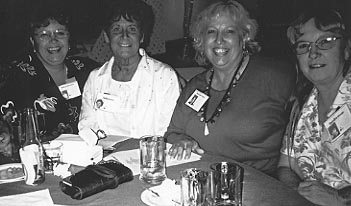
Sandy Kluthe, Judy Aldrich, Judy Landt-Gibson, Sandra Stangle
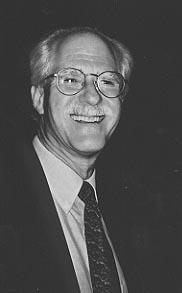
Haim Bober
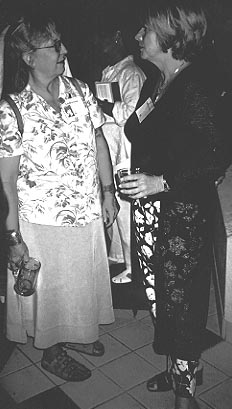
Sandra Stangle and Carole Brown Butzke
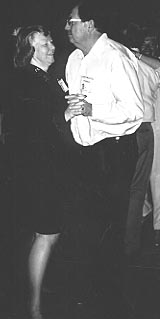
Jerry and Myrna (Rivers)Landt

Judy Smolik and Nancy Shaver Haley
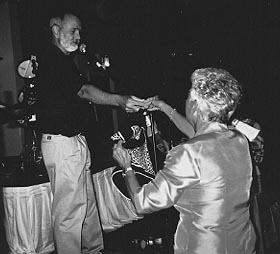
Chuck Buell, our perpetual master of ceremonies, giving a prize to Mary Ann James
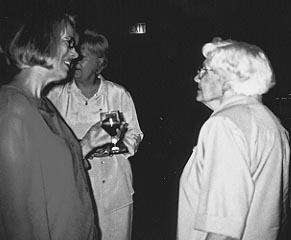
Nancy Shaver Haley talking to teacher Hazel Kellogg
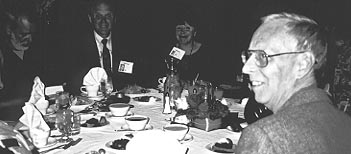
The Spartans: Chuck Buell, John Yirak, Gail (Bober) and Bob Fallbeck
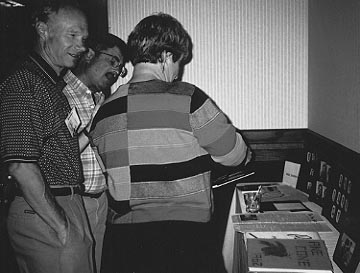
Ron Stember, unknown and Frances Van at the nostalgia table
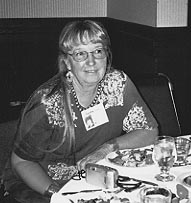
I seem to have a lot of pictures of Sandy

After a lengthy and interesting trip to Egypt during the last two weeks of February, I thought I would write a series of impressions and thoughts contrasting the two societies Family life is culturally defined and it is always enlightening to see another people’s way of handling universal human problems and joys. It is my intention to write several columns on the topic of Egypt, a moderate Muslim society with a 90 percent Islamic population and a secular government that has so far resisted an extremist push to establish it as an Islamic state.
Security
For anyone who has traveled post 9/11 the tighter security and presence of soldiers in the airports is an ever-present reminder of changes we are experiencing. I found extremely tight security measures, politely and competently performed, in U.S. airports. Once past American airports, however, Dutch and Egyptian security was much the same as I experienced two years ago on the same trip. There was a presence of soldiers in Egypt as before and also tight security entering the Egyptian Museum in Cairo and tomb sites in the Valley of the Kings in Luxor.
Most notable, though, was the nearly complete and total absence of American tourists. The last time I traveled to Egypt there were many Americans crowding museums and sites. This time there was about the same number of Germans, British, French and assorted other nationalities. I saw only one group of American tourists in one restaurant and two young women on tour with an Italian group.
Because of this when people asked where we were from and we replied America or USA, their faces would inevitably soften and they would say some version of “welcome.” I only ran into one Egyptian man who wondered what our government was doing with threats to Iran and Iraq. Foreign policy not being my forte, I really had no good answer for him and did not want to get into a political discussion. He was fine letting it go and changing the subject.
The Egyptian character
But other than that I found the Egyptians, as before, some of the kindest, most caring people I’ve ever met. They have no problem asking all about you and concerned about your well being. Mind you, some of these offers of help are motivated by “business.” Never the less it is difficult to feel alone traveling in Egypt.
The owners of the feluccas (Nile sailboats) are very proud. One asked if I could change a $1 American bill to Egyptian pounds. I readily agreed since I knew they had a hard time changing small currency. He would not take the offer of the five-pound note, however, no matter how we insisted, since one American dollar is worth only 4.56 pounds (a difference of about 12 cents).
The family I so looked forward to seeing again, Ahmed Soliman, his daughters and son who own the little hotel on the West Bank of the Nile in Luxor, welcomed me with open arms in what felt like a homecoming. Ahmed told my traveling companion, Scott, “You now have a friend in Luxor.” He means it too. Scott and Yasmine, a Canadian woman who traveled to Luxor with us, were both amazed at the attention they were given for approximately $20 a night for a clean, pleasant room with a terrace. Daughters Menaul and Hala had grown in my two years away. Menaul at 22 is planning a July wedding to the man who owns the Arabian horse stables. Lovely and intelligent girls, they are interested in computers, and Hala is a talented artist. Son Mohammed at 18 is learning the hotel business.
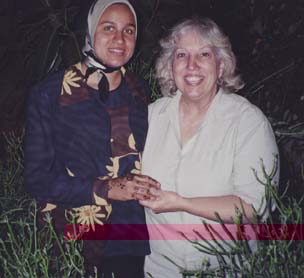
Judy Gibson, at right, with Hala Soliman, 20-year-old daughter of Ahmed who owns the hotel on the west bank of the Nile at Luxor. Hala wears the headscarf by choice she says. She has henna decorations on her hand.
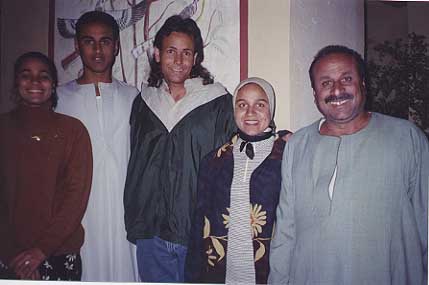
Below the Soliman family from left: Menaul, Mohamed, (friend Scott) Hala and Ahmed
Merenptah was the son of Ramses II and the Pharaoh mentioned in the book of Exodus. This tomb is typical of the experience of studying a tomb starting from the outside sign information and then entering and going down deep into the earth until the sarcophagus is reached in the last room. The decorations on the wall are always fascinating and even more so considering how long they’ve been there.


A particularly haunting photo of Scott in the passageway and a carved relief of lotus flower carriers

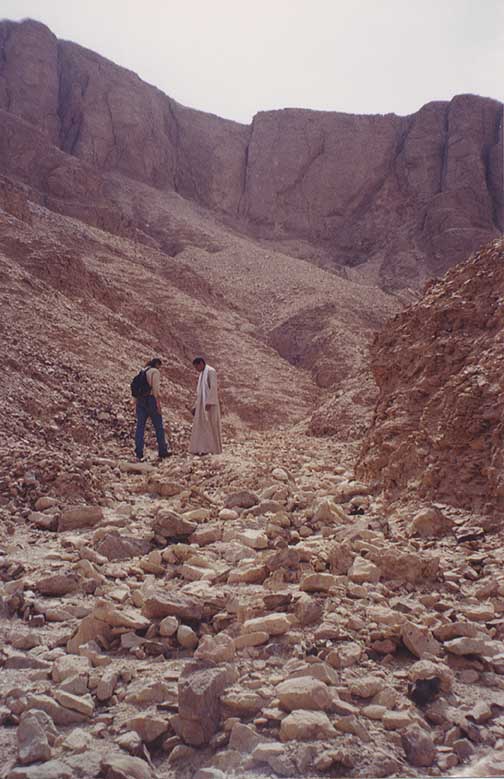
Here is where Scott went looking for his little round rocks. We were the only ones here and our driver, Abdul (pictured with Scott), left us to walk up to the Tomb of Ay, a rather insignificant tomb but a magical and unexplored area. To get there you must take a rather bumpy road off to the right of the tourist entrance to the Valley of the Kings. This place was so beautiful, similar to the Badlands in South Dakota, and I could let down all defenses and just be. You will have to ask Scott the significance for him. He loved it too.

Walking along the road up to the Tomb of Ay - when we finally got there after much meandering, the tomb was locked and deserted. Finally the tomb guard came up the road with two sweating German men - the guard had to start up a generator for lighting and unlock the tomb - we waited while the Germans looked around and then went in. The gift of being alone in this magic place was priceless.

July 13 to 24, 2002

Anne took this photo - so happy!!!

The mud bath at Ojo Caliente mineral springs
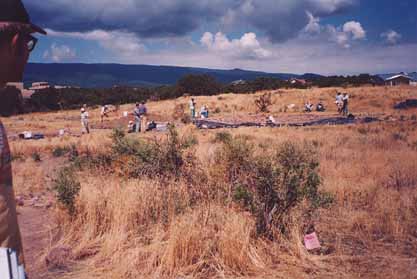
The excavation by University of Chicago team of the Paako ruins - I
Friends and more friends…
And even then I don’t have photos of Anne, or Scott, or Jerry and Myrna …Leslie, Nancy and Phyllis, Ingrid
I was so touched with the outpouring of love

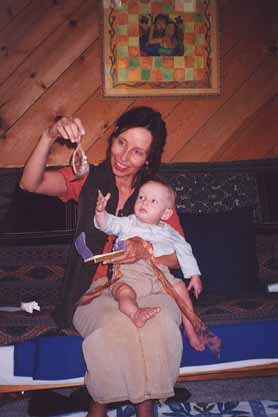

 Sitting at Jerry and Myrna’s cabin in the Jemez Mountains.
Nothing could be more opposite from Cairo than Amsterdam, city of organization and honor system train tickets, city of World War II scenic sights, canals — legalized prostitution, pot and the honoring of alternative lifestyles. We stopped there for 7 hours on our way to Cairo. It was actually quite beautiful, very civilized.


A trip like this has many levels and only on return do some of them start sinking in. In fact, I really want to go back again now, to Egypt. It seems like each trip brings deeper levels of meaning and the first trip, for me, was sightseeing all those things I read about in books and magazines. I also had the completion of a past-life memory there of being an Muslim man — not sure of the time period.
When I left I wasn’t sure I would ever get back, even though I told the Soliman family I would love to come back. It seemed unrealistic. But there I was again, being greeted with open arms, this time it seemed like I was just taking my pal Scott who always wanted to go. I wasn’t sure what the trip was about for me.
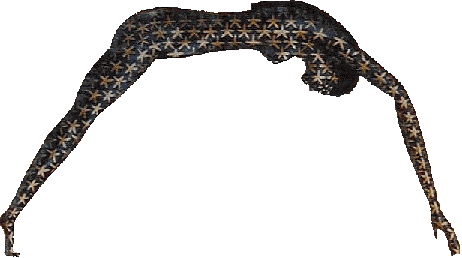
But the first thing was an attraction to the Goddess NUT
During the day, Nut and Geb are separated, but each evening Nut comes down to meet Geb and this causes darkness. If storms came during the day, it was believed that Nut had some how slipped closer to the Earth. Nut is the barrier separating the forces of chaos from the ordered cosmos in this world. Her fingers and toes were believed to touch the four cardinal points or directions. The sun god Re was said to enter her mouth after setting in the evening and travel through her body during the night to be reborn from her vulva each morning. She gives birth to the sun in the east and swallows the sun in the west.
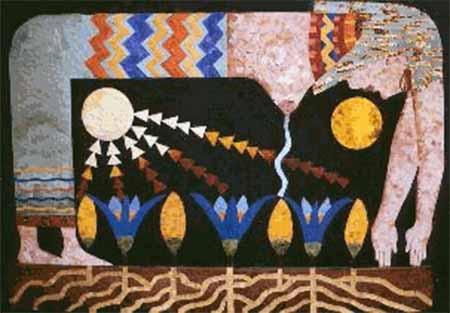
Nut is the Mother of all deities. She united with her brother the Earth god Geb, in a tight and passionate embrace until separated by Shu (‘air’) on the orders of Ra. Ra was annoyed because Geb and Nut had come together without his knowledge or agreement. Expecting that there would be a natural result of their affection, he declared that Nut could not give birth to children on any day of any month of any year. The god Thoth came to Nut’s help. He had been playing draughts with the moon and he had won enough of the moon’s light to make up five new days. Since these days were not on the official calendar, Nut was able to bear a child on each. Nut arches over the earth morning from between her thighs. She is the arching vault of the heavens, Her body sparkling with starlight. Through Her mouth the Sky-boat of the Sun passes each evening, from her vulva the it re-emerges and the day is reborn each morning. She retains some weather working functions; the thunder is her voice.
As Mother Night, Nut represents the unconscious, luna, moon, feminine, the emotional body. Her glyph often depicts two crossed arrows against a leopard skin. Nut is associated with the element air, rainbows and sycamore trees.
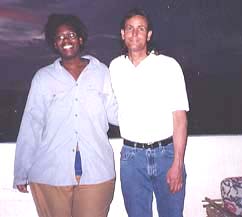
Scott and Yasmine on the Amon rooftop
****ONCE on the train to Luxor (following, by the way, a horrible train fire disaster on the same route – although not a tourist train that we would have been on) the synchronicities and gifts began. We were seated in a first class cabin with three others– two Japanese young men and an African Canadian woman. It was a night train and as I dozed, trying to sleep, I said to Scott and Yasmine the black woman, — “we have all four races here – red, yellow, black and white.” Scott smiled and said, “Judy has those kinds of thoughts when she goes to sleep.” hmmmm.
Later it occurred to me that not only did we have all four races, but probably in the proportions of their numbers on earth. Two Asians, one black, one and 3/4 white and 1/4 American Indian. Am I crazy or what?
~~~~~~~~~~~~~~~~~~~~~~~~~~~~~~~~~~~~~~
Family Times column
Judy Gibson
March 23, 2002
I’ve been thinking, lately, about curiosity.
Two things inspired this — first was the privilege of meeting Kent Weeks and his wife Susan in Egypt. Weeks found the tomb known as KV5 in the Valley of the Kings in Luxor in 1989 — called the greatest find since the discovery of the unraided tomb of Tutankhamun. His book “The Lost Tomb” reads like a novel.
The second inspiration was an essay in Time magazine about Daniel Pearl, the journalist who was kidnapped and killed in Pakistan by terrorists. Lance Morrow wrote that Pearl was the sort of journalist who had curiosity, “the noblest form of intellectual energy.” He also mentioned what novelist John Hersey said about Henry Luce, “He was amazed and delighted to learn whatever he had not known before.”
Kent Weeks, a beaming and happy person, told me he had been interested in Egypt since he was a child, that he’s been an archeologist for decades and “never wanted to do anything else.” He takes obvious pleasure in his lifework, appreciating his wife and her contribution as project artist. His love of Egypt and the Egyptian people — ancient and present — is evident. At the risk of waxing too eloquent, they seemed like a couple of angels there — always dressed in white (due to the heat, I’m guessing).
He and his wife rise early and drive their dated Toyota Land Cruiser out to the site for another day of discovery and hard work. Their home is in Cairo but when they are on site in Thebes (the ancient name for Luxor) they stay at the same modest family hotel where I stayed. When they introduced themselves to my friends and me on the roof of the hotel where we had gone to watch the sunset, my mouth dropped and I said, “The well known person.” He smiled and kidded modestly, “I don’t know – my wife knows me well.”
The story of the extensive Theban mapping project and discovery of KV5 — the agony and the ecstacy of it — is too lengthy for this column. For anyone interested I would recommend his book that was excerpted in a wonderful National Geographic article in 1998. They also have an interesting and well done website where one can take a virtual “fly through” tour of the tomb, the largest of all tombs discovered so far in the valley.
It was inspiring to meet someone face to face, so dedicated and committed to what he was doing — and a kind and positive person at that. I bought a copy of his book and asked him to sign it for my friend which he did graciously. I apologized for being a “groupie.” He said, “That’s O.K., groupies are my life.” I know what he meant since the work he is doing is costly and they need financial support from people who also believe in what they are doing.
Another interesting thing — I had no desire to join his group or go back to school to study archaeology. What I took away from that exciting encounter was a renewed dedication to my own curiosity. I, too, love finding out things.
This is a gift we can give our children — the love of pure learning and discovery. As parents we can model interest in the world around us and share exciting discoveries of our own. Nurture curiosity.
“The Lost Tomb: This is his incredible story of KV5 and its excavation” by Kent R. Weeks, Ph.D., Harper Collins, 1999.

This is a view of the Valley of the Kings in Thebes this February. The large opening into the hillside is an entrance to a tomb. People who have visited the area in the past will note the small number of tourists due to the aftermath of 9/11.

“Dr. Kent” Weeks as he is fondly called,
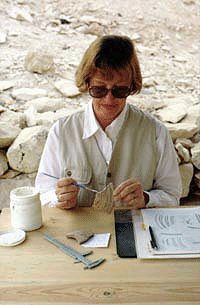
Susan Weeks, project artist, gluing together pot sherds. She works at the tomb entrance under the scrutiny of hordes of tourists. She was patient with them all including me. She talked a little to us while she worked and recommended a good tomb to visit.
~~~~~~~~~~~~~~~~~~~~~~~~~~~~~~~~~~~~~~~
(photos of Kent Weeks and Susan Weeks courtesy of the Theban Mapping website)

******Upon arrival at Luxor, there was my friend Ahmed Soliman to meet us as if I had only left yesterday. Yasmine didn’t have a place to stay and she was ill from the motion of the train – Ahmed said of course she could come along and he found her a room in his hotel, although not one of the great rooms like the two we had – he was full. Which I was actually glad to know because I was wondering if 9/11 had become a problem for his business. I recalled, though, most of the people staying there were German.
The next amazing thing that happened was meeting famous person Kent Weeks and his wife Susan who stay at Ahmed’s hotel during the time they work at excavating KV5 in the Valley of the Kings. I wrote a column about this:
Visiting the tombs and temples in Thebes (Luxor) was much more pleasant than last time. The time of year (February) meant that the weather was bearable and unfortunately for the Egyptians but fortunately for us 9/11 meant very few tourists in the sightseeing spots.
We could relax, feel at home and safe here in this little hotel in the village. When we did venture out to sightsee Ahmed arranged the same wonderful driver, Abdul, who chauffered us around last time. Looking back it was at this time that a deep shift settled in for Scott and me too. Talking to him on the phone when we got back he said it felt like he had undergone a change that was something like “developmental.”
I know what he meant. Things changed for me too. I will try to describe it. Something basic, like a deeper acceptance of who I am, and maybe the beginnings of grieving for what I am not or won’t be again. One way this manifested is the mundane issue of my body image, dieting and food issues, and evidence of aging. I had been going to Weight Watchers and feeling determined to lose weight and had images of myself in my mind of being thin and how I would feel then. I was able to lose about 15 to 20 pounds, but hoped to lose a lot more. I began, after Egypt, to let this go, after coming back from a place where I was so accepted for myself, and could be nothing other than myself. I have been experimenting with eating what I want and only trying to be aware of what I REALLY want to eat or drink — not eating for “medicine” or boredom or out of habit.
We are redoing the format of the newpaper at work and all us columnists were having our picture retaken. I had been dissatisfied with mine. The other day (A.E. – after Egypt) I joked with my editor that I guess there is not a camera in the world that will make me look 25 again. And, really, that is something to grieve over, never being 25 again — I don’t think I have done any of that grieving. It’s the point that no matter how much weight is lost, how many new pretty clothes, make-up, etc. ad nauseum – I can’t be young again, and will never be.
~~~~~~~~~~~~~~~~~~~~~~~~~~~~~~~~~~~~~~~~~~~
We got on the wrong train from Luxor to Cairo on our return. It seems we should have waited for the next train but got on one that was in the station at the right time and found our assigned seats in car number 5.
After two more stops a bunch of Egyptians piled in and it quickly became obvious (although not through any language communication) that our seats were not ours. A patient Egyptian couple and others calmly repeated Arabic words to us over and over more slowly than the last time, hoping that we would finally understand. Finally a man who spoke English way back in the car interpreted – “This train not for you.” — We had gathered that but were reluctant to get off in the middle of Egypt in the middle of the night — (night train, of course). “No,” he said, “if you get off at next stop you can get train that is for you.”
At this point the conductor in a scruffy green jacket, obviously inebriated, came to help us with our stuff and we vacated our seats to stand in the little doorway to wait expulsion at — Qena.
When we disembarked at Qena we were relieved to see it seemed like a real train station and town. Scott said the worst that could happen is that we would have to find a hotel and then deal with the whole thing the next morning. Voice of reason — good guy!
Then I made the mistake of reading the Lonely Planet guide to see where we were — about 1 a.m. in the middle of Egypt. Wouldn’t you know this part of Egypt has a bad reputation for terrorist activity – the government had found it difficult to control the extremist groups in this area because of the ease of hiding and escaping into the desert. Tourist travel is not recommended.
Well, we did finally get the train that “is for you” everyone had been patient and kind. I thought of what would have happened we had taken someone’s seat elsewhere in the world, I don’t think “kindness” would have come to mind.

Nag Hammadi
Nag Hammadi, down the railroad track from Qena, is the site where a collection of thirteen ancient codices in a Coptic dialect was discovered in 1945. These are “primary Gnostic scriptures” texts once thought to have been destroyed during the early Christian struggle to define “orthodoxy.” These texts, along with the Dead Sea Scolls found about the same time but in Palestine, make up a body of work that were repressed or hidden for their preservation by two groups — the Essenes in Palestine and the ancestors of the Ancient Egyptians, probably a Coptic sect.
The Coptic Christians make up about ten percent of the present population of Egypt and many think they are the best remnant of the Pharaonic Egyptians left, with their sacred language a “survival” from ancient times.
When we were waiting in the train station at Qena, Scott saw what must have been a Coptic bishop also waiting for a train. Scott said people were coming over to kiss his hand.
So – Qena/Nag Hammadi — terrorist stronghold or sacred ground — Both, is my guess, which brings me to a fascinating book I found online (ain’t the internet great?) Jung and the Lost Gospels: insights into the Dead Sea Scrolls and the Nag Hammadi Library. This book talks about how at the darkest times – comes the light,i.e. these texts found following World War II, the Holocaust and the atom bomb. Maybe now again we are having a dark time when there will be another leap forward. I also found, before I left, a wonderful book The Pharaoh’s Shadow: travels in ancient and modern Egypt by Anthony Sattin and only available from Amazon.co.uk. Sattin is in search of culture that has survived from ancient times in Egypt and the Coptic connection is well described.
Family Times column
Judy Gibson
March 23, 2002
I’ve been thinking, lately, about curiosity.
Two things inspired this — first was the privilege of meeting Kent Weeks and his wife Susan in Egypt. Weeks found the tomb known as KV5 in the Valley of the Kings in Luxor in 1989 — called the greatest find since the discovery of the unraided tomb of Tutankhamun. His book “The Lost Tomb” reads like a novel.
The second inspiration was an essay in Time magazine about Daniel Pearl, the journalist who was kidnapped and killed in Pakistan by terrorists. Lance Morrow wrote that Pearl was the sort of journalist who had curiosity, “the noblest form of intellectual energy.” He also mentioned what novelist John Hersey said about Henry Luce, “He was amazed and delighted to learn whatever he had not known before.”
Kent Weeks, a beaming and happy person, told me he had been interested in Egypt since he was a child, that he’s been an archeologist for decades and “never wanted to do anything else.” He takes obvious pleasure in his lifework, appreciating his wife and her contribution as project artist. His love of Egypt and the Egyptian people — ancient and present — is evident. At the risk of waxing too eloquent, they seemed like a couple of angels there — always dressed in white (due to the heat, I’m guessing).
He and his wife rise early and drive their dated Toyota Land Cruiser out to the site for another day of discovery and hard work. Their home is in Cairo but when they are on site in Thebes (the ancient name for Luxor) they stay at the same modest family hotel where I stayed. When they introduced themselves to my friends and me on the roof of the hotel where we had gone to watch the sunset, my mouth dropped and I said, “The well known person.” He smiled and kidded modestly, “I don’t know – my wife knows me well.”
The story of the extensive Theban mapping project and discovery of KV5 — the agony and the ecstacy of it — is too lengthy for this column. For anyone interested I would recommend his book that was excerpted in a wonderful National Geographic article in 1998. They also have an interesting and well done website where one can take a virtual “fly through” tour of the tomb, the largest of all tombs discovered so far in the valley.
It was inspiring to meet someone face to face, so dedicated and committed to what he was doing — and a kind and positive person at that. I bought a copy of his book and asked him to sign it for my friend which he did graciously. I apologized for being a “groupie.” He said, “That’s O.K., groupies are my life.” I know what he meant since the work he is doing is costly and they need financial support from people who also believe in what they are doing.
Another interesting thing — I had no desire to join his group or go back to school to study archaeology. What I took away from that exciting encounter was a renewed dedication to my own curiosity. I, too, love finding out things.
This is a gift we can give our children — the love of pure learning and discovery. As parents we can model interest in the world around us and share exciting discoveries of our own. Nurture curiosity.
“The Lost Tomb: This is his incredible story of KV5 and its excavation” by Kent R. Weeks, Ph.D., Harper Collins, 1999.
This is a view of the Valley of the Kings in Thebes this February. The large opening into the hillside is an entrance to a tomb. People who have visited the area in the past will note the small number of tourists due to the aftermath of 9/11.
“Dr. Kent” Weeks as he is fondly called,
Susan Weeks, project artist, gluing together pot sherds. She works at the tomb entrance under the scrutiny of hordes of tourists. She was patient with them all including me. She talked a little to us while she worked and recommended a good tomb to visit.
(photos of Kent Weeks and Susan Weeks courtesy of the Theban Mapping website)