The Goddess Nut (pronounced Noot)

Nut_sarcophagus

Cairo Antiquities Museum sarcophagus

I became enchanted with this Goddess from the first day I saw the image in the Cairo Antiquities museum carved into the lid of a sarcophagus- she is the sky “mother.” We found the image all over Pharonic Egypt. Painted into the ceilings of tombs and illustrated elaborately on papyrus in connection with a Pharonic calendar.

Nut_calendar

Queen/goddess Nut image with calendar

The following is from the web:

Egyptian goddess of the sky and of the heavens. Daughter of the air god Shu and Tefnut, the goddess of moisture, in the Heliopolitan genealogy. She was typically depicted as a woman with her elongated and naked body arching above Shu and the earth god Geb to form the heavens. Sometimes she appeared in the form of a cow whose body forms the sky and heavens. Nut was the barrier separating the forces of chaos from the ordered cosmos in this world. Her fingers and toes were believed to touch the four cardinal points or directions. The sun god Re was said to enter her mouth after setting in the evening and travel through her body during the night to be reborn from her vagina each morning. Nut was also a goddess of the dead, and the pharaoh was said to enter her body after death, from which he would later be resurrected. Her principal sanctuary was at Heliopolis.

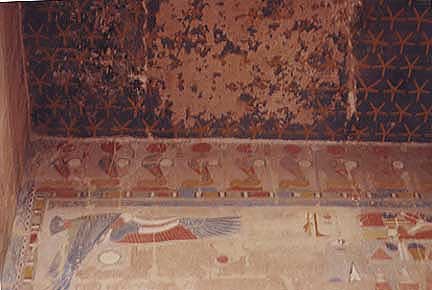
Nut_ceiling_2

ceiling stars - Nut - at Hatchupset temple in Luxor

Now for the “wo-wo” thing (cue Twilight Zone theme) When I was surfing the web to find info on Nut I found a site that connected, for the author, Nut and the myths about “Spirals”

Nut web site (click here)

My spiral path page (click here)

Brooke Animal Hospital, Luxor

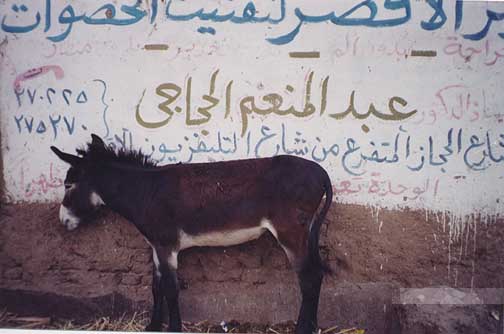
donkey_web

One unusual experience I had in Egypt was visiting Brooke Animal Hospital in Luxor. This free veterinary clinic also has branches in Cairo, Pakistan, India and Jordan — all places where horses and donkeys are still used extensively for work.

The hospital was started in 1934 by Dorothy Brooke, an English woman who had compassion for military horses used in the desert during World War I that were sold off into poor conditions following the war. The British are famous for their love of animals and she must have felt much as I did seeing some horses and donkeys in Egypt in sad shape, some being mistreated.

Egyptian animal owners for the most part do care, if only because a healthy animal adds to the welfare of the whole family. But poor people need money first to care for their families and understandably put an animal’s care after that.

In Luxor the clinic, started in 1966, treats any animal for free. Literature from the hospital says the clinic provides more than 2,300 treatments per month. I was given a tour of the meager facility with donkeys and horses occupying “inpatient” stalls. Horses pull “calishes,” the carriages that transport tourists along the Nile and to Karnak Temple. Donkeys are often owned by young boys in the rural areas and are used to transport goods and pull carts. These young boys enjoy riding their donkeys, too. I saw a group of them trotting through the streets of the little village much as we might see our youngsters riding bikes.

I am aware there are many humans in Egypt and other countries who need aid, but the plight of domestic work animals touches my heart. Animal lovers the world over will be inspired by these people who work in such overwhelming conditions to help the most helpless of creatures.

For me, a visit to that animal hospital on the other side of the world, made a human connection. Here I received the most thoughtful inquiry about the United States after 9/11. The kind young staff person who showed me around asked, in his limited English with much concern, if Americans were, “beginning to forget.” Looking into his eyes, I knew what he meant. Are we recovering? Are we sorting through the madness to distinguish the bad from the good? He asked, much like someone witness to a crime or an accident will stop, bend over the victim in concern and ask, “Are you O.K.?”

There is good and evil in all societies and there is good and bad in all of us. My visit, witnessing their service to animals and leaving them a little of my traveling money, made a connection from the best in me to the best in them. I told him yes, we’re getting better. I think he, too, understood what I meant.

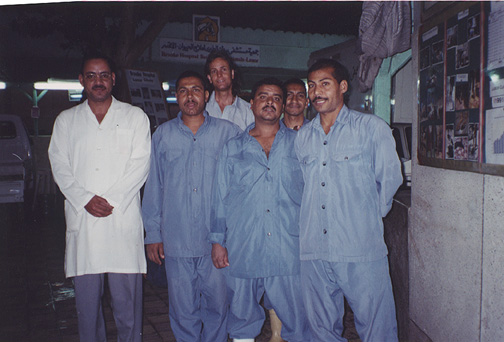
Vet_team_-_brooke

The staff of Brooke Animal Hospital in Luxor on Feb. 26. Dr.Emad,veterinarian, is in the white coat. My friend Scott is the tall one in the back row.


Brooke Hospital for Animals is a registered charity in England. The address

is Broadmead House, 21 Panton Street, London SW1Y 4DR

There is also a nice website www.brooke-hospital.org.uk


dropped off at Qerna, terrorist territory and Nag Hammadi

We got on the wrong train from Luxor to Cairo on our return. It seems we should have waited for the next train but got on one that was in the station at the right time and found our assigned seats in car number 5.

After two more stops a bunch of Egyptians piled in and it quickly became obvious (although not through any language communication) that our seats were not ours. A patient Egyptian couple and others calmly repeated Arabic words to us over and over more slowly than the last time, hoping that we would finally understand. Finally a man who spoke English way back in the car interpreted – “This train not for you.” — We had gathered that but were reluctant to get off in the middle of Egypt in the middle of the night — (night train, of course). “No,” he said, “if you get off at next stop you can get train that is for you.”

At this point the conductor in a scruffy green jacket, obviously inebriated, came to help us with our stuff and we vacated our seats to stand in the little doorway to wait expulsion at — Qena.

When we disembarked at Qena we were relieved to see it seemed like a real train station and town. Scott said the worst that could happen is that we would have to find a hotel and then deal with the whole thing the next morning. Voice of reason — good guy!

Then I made the mistake of reading the Lonely Planet guide to see where we were — about 1 a.m. in the middle of Egypt. Wouldn’t you know this part of Egypt has a bad reputation for terrorist activity – the government had found it difficult to control the extremist groups in this area because of the ease of hiding and escaping into the desert. Tourist travel is not recommended.

Well, we did finally get the train that “is for you” everyone had been patient and kind. I thought of what would have happened we had taken someone’s seat elsewhere in the world, I don’t think “kindness” would have come to mind.

nag_hammadi_map

(Nag Hammadi link click here)

Nag Hammadi, down the railroad track from Qena, is the site where a collection of thirteen ancient codices in a Coptic dialect was discovered in 1945. These are “primary Gnostic scriptures” texts once thought to have been destroyed during the early Christian struggle to define “orthodoxy.” These texts, along with the Dead Sea Scolls found about the same time but in Palestine, make up a body of work that were repressed or hidden for their preservation by two groups — the Essenes in Palestine and the ancestors of the Ancient Egyptians, probably a Coptic sect.

The Coptic Christians make up about ten percent of the present population of Egypt and many think they are the best remnant of the Pharaonic Egyptians left, with their sacred language a “survival” from ancient times.

When we were waiting in the train station at Qena, Scott saw what must have been a Coptic bishop also waiting for a train. Scott said people were coming over to kiss his hand.

So – Qena/Nag Hammadi — terrorist stronghold or sacred ground — Both, is my guess, which brings me to a fascinating book I found online (ain’t the internet great?) Jung and the Lost Gospels: insights into the Dead Sea Scrolls and the Nag Hammadi Library. This book talks about how at the darkest times – comes the light,i.e. these texts found following World War II, the Holocaust and the atom bomb. Maybe now again we are having a dark time when there will be another leap forward. I also found, before I left, a wonderful book The Pharaoh’s Shadow: travels in ancient and modern Egypt by Anthony Sattin and only available from Amazon.co.uk. Sattin is in search of culture that has survived from ancient times in Egypt and the Coptic connection is well described.

Stages of life

Family Times

Dells Events

Feb. 16, 2002


There are many pleasures watching the winter Olympics and one of them is pure appreciation for the physically beautiful young athletes. In the prime of their lives, at top physical condition, their health and beauty shine forth. The lovely figure skaters, graceful and stunning, the speed skater who after the race, strips off his tight hood to reveal a shock of sandy colored hair, all are breathtakingly gorgeous. And they are gorgeous in a way that is not an icon, a decoration or an airbrushed photo shoot.

It got me thinking if there was any time in my life I was anywhere near like that. I think it was right before my first child, in my late teens, early 20s. I took my health and grace for granted, blessed with a slim and smoothly working body.

Our journey in life has several paths. The physical one peaks rather early. Brett Favre, our Wisconsin favorite, is now pushing the envelope of prime football age at 32. Most human beings are at their best physically in their late teens and 20s and literally it is all down hill from there. As Bette Midler said, “After thirty my body decided it wanted a life of its own.”

Heroic measures are attempted to stem this tide since sexual attractiveness is based, biologically, in “fecundity” – signs of ability to reproduce. The newest form of stemming the aging tide is something called Botox, a botulism neurotoxin that paralyses muscles and erases wrinkles leaving the face with the inability to scowl. Too bad, I say.

I prefer to consider other paths on this journey of life that peak at different times later in life.

The psychological journey, for example, I believe peaks somewhere about where I am right now. Finally, I have resolved those pesky childhood issues and learned to accept others and myself as we are imperfections as well as strengths. I am past expecting myself or others to be perfect. It is also the beginning of the time of life I notice married people seem to be happiest. One psychologist said that marriage is for finishing your childhood and if you finish your childhood you can live “happily ever after.”

The intellectual journey peaked for me somewhere earlier than now. I think it was maybe in my 40s when I learned new things rapidly, finding myself in situations where I needed a swift learning curve and I was up to it. Nowadays I don’t retain as much as I used to when reading things. More often now I forget where I¹ve placed something and find myself standing in a room not remembering why I’m there.

But I believe the peak of the spiritual journey is still ahead. One could see it as a preparation for death, but I prefer to see it as the time of life other things diminish in importance and we are faced with the primary issue of conscious humankind that more and more in the years ahead when my work-a-day world diminishes and I have more time to ponder and connect spiritually.

This is what it is to be human. Those beautiful young people, although we nearly worship them, are only one stage in this earthly life.

Thomas D. Crist Obituary

Obituary that appeared in Wisconsin State Journal on Friday, Jan. 18, 2002 and The Wisconsin Dells Events on Sat. Jan. 19, 2002


Thomas D. Crist, 81, of Wisconsin Dells died peacefully on Tuesday, Jan. 15, 2002 at St. Clare Hospital in Baraboo.

Tom was born Aug. 25, 1920 in Ashland, Wis., the son of Edna (Meyer) and Thomas Crist. The family moved to Kilbourn, now Wisconsin Dells, when he was two-years-old. He attended grade school and graduated from Wisconsin Dells High School in 1939 and earned a bachelor degree in science from the University of Wisconsin-Madison in 1947.

During World War II, serving as an Army Air Corps First Lieutenant, Tom attended pilot, aerial gunnery and navigator school. He served as an aerial navigator flying 40 bombing missions in a B-24 Bomber in the South Central Pacific. He received six air medals and The Distinguished Flying Cross.

The Crist family owned and operated Dells Ice Cream and Tom was part owner with his father for 18 years. He also worked as an investigator in the Dairy, Food and Trade Division for the Wisconsin Department of Agriculture in Madison from 1965 to 1972 and was the Director of the Bureau of Consumer Protection from 1972 to 1982.

After retirement he and his wife moved back to the Dells and Tom served as mayor of Wisconsin Dells for two terms from 1984 to 1988. He was also a member of the Wisconsin Dells School Board, serving as clerk from 1947 to 1964 and was a vice president of the Wisconsin State School Board Association in 1963. He was a member of the St. Clare Hospital Advisory Board from 1989 to 1994 and a life member and a Commander of the American Legion in the Dells. He was also a member of the Board of Directors for Dells Housing, a member of the Dells Country Historical Society and a member and elder of the United Presbyterian Church in Wisconsin Dells.

Tom is survived by his wife Nona (Landt); sons David, Alan (Marie) and Peter (Diane); nine grandchildren and four great-grandchildren; sisters Barbara Marini and Lu Schweiger; brother-in-law Eugene Landt; nieces, nephews and other relatives and friends. He was preceded in death by one infant brother and his parents.

A family graveside service will be held at Spring Grove Cemetery in Wisconsin Dells at 10:30 a.m. Sat. Jan. 19. A memorial service will be held at 1:30 p.m. Saturday, Jan. 19 at the United Presbyterian Church, 730 Cedar St., Wisconsin Dells, the Reverend Steven Keller officiating.

Fedderly-Axel Funeral Home of Wisconsin Dells assisted the family with arrangements.

Memorials may be made in his name to the Alzheimer’s Association, P.O. Box 64421, St. Paul, MN 55164, or to the United Presbyterian Church, Wisconsin Dells.


Christmas and New Year’s 2001

Christmas_2001

New_Year_2002

New Year's eve at the del-Bar

dad_and_rosie_1

New Mexico Christmas – alone

This Christmas, all across the country, people are trying to figure out how to have a merry one even though their families are split by divorce or they are suffering some other loss.

My children were about seven and ten when their father and I divorced and after a year of difficulty and bitterness, we made our peace and carefully planned ways to minimize the effect on the children.  I think we did a pretty good job but there is no getting around the grief and emptiness.

These plans meant that we, like many other families, traded off holidays. This value of fairness persists in our family even to this day when my children are in their 30s and in-laws complicate the plans. I was so happy to have both children, a son-in-law, my Dad and a niece and her husband with me this Thanksgiving–a rare treat.

My heart goes out, with supreme understanding, to all who struggle with loss at the holidays. I remember with vivid clarity the time I spent Christmas totally alone.

I was living in New Mexico on San Juan Pueblo land in a little 100-year-old adobe house with a tiny propane heater supplementing the wood heat.  That year the grown-up kids were at their Dad’s and for some reason, saving money perhaps, I decided not to go to my own parents. All my close friends in Santa Fe had gone to visit their parents, or were having their own traditional family celebrations. I know all I would have had to do was mention that I was going to be alone and I would have had invitations, but I was too proud.

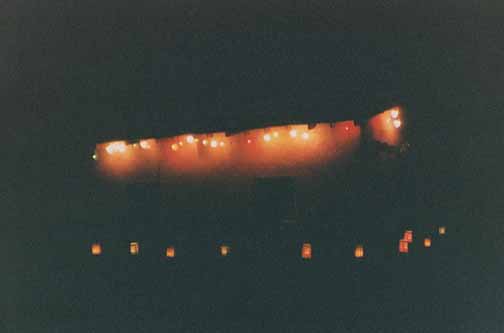
Farolitos and Christmas lights, San Juan Pueblo

Farolitos and Christmas lights, San Juan Pueblo

Pueblo people in New Mexico have lived in the same place for centuries. They never suffered the dislocation forced on most other tribes, although they certainly did suffer repression of their religion and customs. Pueblo children were sent to government schools where their hair was cut and they were punished for speaking their Tewa language. The tribes incorporated many Catholic traditions, finding a way to weave them into the structure of their own beliefs, a lesson we could all learn given these times of religious fanaticism.

It was in this setting that I found myself alone on that Christmas nearly a decade ago. My closest neighbors, part of a large Pueblo family, were at the husband’s parents for Christmas on the other side of the pueblo. All was quiet in our little neighborhood.

I bought a tree for myself and figured out how to turn on some ancient Christmas lights that had never been taken down still hanging on the eaves. On Christmas Eve I made my own farolitos, little lights made by placing a votive candle in sand in the bottom of a paper bag.

And then I walked up to the pueblo plaza where the tribe was dancing. The Matachina dance is only on Christmas Eve, and not every year. The men dance accompanied, oddly enough, by fiddlers as well as traditional drummers. The dancers are fierce looking with a sweep of dark fringe covering their faces. The dance is rapid and intense– no smarmy silent night here–the mood is deeply, almost angrily, emotional.

My breath was taken away–some powerful force was at work here, some blending of native and European, some calling of spirits, some celebration of vigorous life. Whatever it was went straight into my unconscious, completely bypassing reason, as if in a dream. I was stunned.

It was snowing lightly as I walked back home and most of my farolitos were still burning. They are to be left burning all night “to light the Christ Child’s way.”

In the morning snow covered the ground and the farolitos were all burned out. I lit a fire, made coffee and opened packages alone. I cried, missing my children. I remember my mother sent me a lovely angel statue, which made me cry more.

Then I bundled up and took off walking with my dog, Freddie. Uno, Snowflake and Cricket, the neighbor’s motley crew of dogs, joined us as we walked over snow covered pepper and squash fields, irrigated in the summer, down to the banks of the Rio Grande. The beach, covered with smooth peebles, was now also covered in snow. The river flowed strong and silent—the dogs waded out a ways for a drink. I thought I was pretty lucky, all in all.

Snow at the pueblo backyard looking towards the fields, Christmas morning

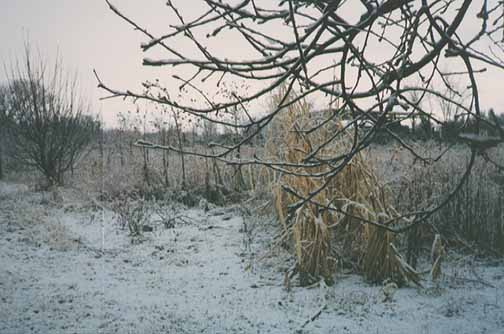
Snow at the pueblo backyard looking towards the fields, Christmas morning

Dec. 8, 2001

Van Gogh and the cranes

FAMILY TIMES
____________
Judy Gibson
Dells Events
October 27, 2001

cranes1big

Two occasions of truth and beauty brought tears to my eyes in the space of two days last week.

The first was the sight of the valiant, inexperienced whooping cranes, nearly the last of their kind, following a little noisy plane over the river, learning how to migrate between Wisconsin and Florida.

I waited along with a small group of people on the Wisconsin River for a good look at the cranes that lift off first thing in the morning. I thought of all the effort and the money being spent to try to save these stunning birds from extinction. But that wasn¹t what made me cry. I cried when I saw them in the sky, coming out of the mist, following as they are born to do in that V formation

Even geese, plentiful as they are, flying in that formation high in the sky makes me catch my breath. I’m not sure what it is although it may be the perfect integrity of the natural world combined with the beauty and grace of the birds flying in a flock, their own extended family, doing together what they could not do alone.

This time that feeling was multiplied by a hundred as these historic birds soared above on a mission they were unaware of.

How fragile is life.

starry_night

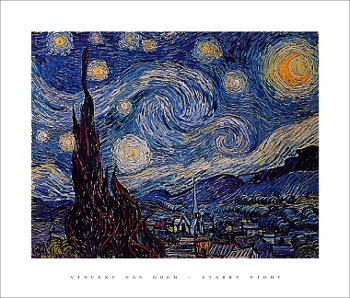
The second occasion was in stark contrast to standing out at dawn on the river My son lives in Chicago and this gives me an excuse to visit the wonderful art museum there. The next day after the cranes, I stood in front of Vincent Van Gogh’s painting, “The Starry Night.” Of course I am very familiar with this painting of swirly pattern around the moon and dots of stars in the sky over the south of France.

I have loved this painting, but nothing compares to standing a few feet away feeling an impact of the beauty and almost painful tenderness. Van Gogh painted this toward the end of his life, he killed himself not long after, and he painted it while he was in an asylum. The exhibition was so well done, illustrating the friendship and competitive artistic relationship between Van Gogh and Paul Gauguin.

Van Gogh was so excited about Gauguin’s coming to stay with him that he painted something just to hang in the room he furnished to please him. Van Gogh was much less sure of himself and it was agony to keep his own integrity in the presence of Gauguin. It was also when his own mental health was crumbling. Then, out of that pain and near the end of his time on earth, he painted this pulsing masterpiece.

I found myself tearing up there, ignoring the crowd of other people moving around me. My son said you could feel the energy coming out of the painting.

It felt just like when I saw the cranes.


Endangered Whooping Crane human-led migration

Dells Events
Oct. 24, 2001
photo and story by Judy Gibson

I received an award for this story, along with a couple of follow-ups on the subject, from the Wisconsin Newspaper Association. It earned a certificate of merit from the Scripps Howard Foundation Award for Environmental Reporting. My proud moment – quote from the reviewer;  “…The prose is both readable and almost as engaging as its subjects.”


cranes1big

The mist rose from the Wisconsin river at dawn on Friday where a little group of people were gathered to watch and photograph the ultra-light human-led whooping crane migration.

“They’ve got birds,” someone said as the two tiny planes were sighted. As the aircraft approached one could make out the young whoopers flying in formation off the wing. The early morning quiet was pierced with a loud “gronk,” the sound that gave the birds their name that hasn’t been heard in the wild over the Wisconsin River for decades. The whoopers were on their way.

The small flock, led by three ultra-light aircraft, had lifted off from Necedah National Wildlife Refuge in Adams County near dawn two days before in an effort to restore migrating whooping cranes to eastern North America. By Monday they had passed out of Adams and Sauk Counties and were in Green County.

The cranes are being taught a new 1,250-mile migration route to wintering grounds at Chassahowitzka National Wildlife Refuge in Florida. It is hoped the young whoopers will return to Wisconsin on their own next spring. If successful the migrating flock will be one of only two remaining flocks left migrating naturally in the wild. The only flock left, up until now, has been a group that migrates between Kansas and Texas.

The trip has not been without problems and anxiety for all those involved, a cooperation of several organizations, public and private, to help restore the endangered bird to the wild.

George Archibald, co-founder of the International Crane Foundation (ICF) in Baraboo, was on hand on Friday to photograph and watch the cranes.

“Our staff helped with raising the cranes and we will be 100 percent in charge in Florida,” said Archibald. He added they will monitor the cranes as they migrate back.

Operation Migration from Canada has expertise in training the cranes to follow the aircraft as if it were a parent. An elaborate system is set up to get the young birds used to the noise and sight of the aircraft without imprinting on human beings meaning that all of the people involved in feeding and leading the chicks wear a baggy white outfit with an adult whooping crane head puppet on the end of one arm. The noise of the aircraft was even played to the chicks while they were still in the eggs.

The operation is expensive and fragile, with biologists and other experts counting on the crane’s natural instincts to migrate and breed. The journey has not been without it’s heart stopping moments. One of the first problems was an errant No. 4 bird who wouldn’t fly along with the others, taking off on his own last Wednesday and after spending a few hours soaring high in the sky, returned to a spot near the refuge, confused and a little frightened.

According to the Operation Migration website posting, No. 4 also appeared to be having a negative influence on No. 6 who would follow him every time he would break off from the group. For this reason the Operation Migration crew decided to crate No. 4 and transport him to the stopovers. As of Monday No. 4 was still following by crate and the others were flying in excellent formation.

Another early obstacle was the necessity of crossing busy I90/94 near the Dells.

On Friday, according to Heather Ray, Administrative Director of Operation Migration, three of the cranes turned back, not wanting to fight the headwinds—the pilots thought it was a good idea and turned back also.

Another attempt on Saturday also failed “. . . the roar of the passing trucks was too much for our inexperienced cranes and they immediately exploded upwards and scattered in every direction. They regrouped quickly and were very willing to follow either aircraft as long as it did not attempt crossing that noisy river of perceived danger.”

The next day the cranes crossed successfully with a quick turn by the pilot at 400 feet.

“Before they realized it, they were across,” said Ray.

Since then the cranes have made steady progress flying 21.4 miles on Sunday and 48 miles on Monday, skipping a planned stop. It is possible to follow the crane progress on the Operation Migration website. There are also video clips on the site of the puppet and ultra-light training plus a clip of a whooper egg hatching. http://www.operationmigration.org

The International Crane Foundation in Baraboo is a founding member of the Whooping Crane Eastern Partnership (WCEP), the group undertaking this historic effort. Its website is http://www.savingcranes.org The WCEP partners are a diverse group including ICF, United States Fish and Wildlife Service, USGS Patuxent Wildlife Research Center, the Wisconsin Department of Natural Resources, the National Fish and Wildlife Foundation and Natural Resources Foundation of Wisconsin and Operation Migration. The website for the partnership is http://www.bringbackthecranes.org.


(Related Family Times column)


Daniel’s story

danile_in_bras_sshop

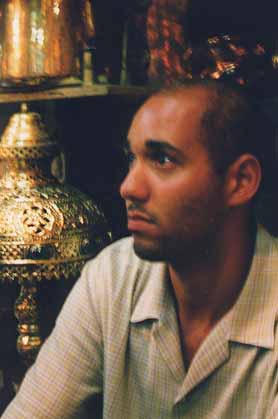
Daniel in the copper shop in the Khan al Khalili in Cairo, October, 1999

My friend and journalist colleague, Daniel del Castillo, was in Afghanistan on Sept. 11 doing research and taking photos for stories for his publication, “The Chronicle of Higher Education.”

I met Daniel in Egypt last year. He is a friend of Michele’s and although he is half Lebanese and half Spanish and speaks fluent Arabic, he was born and raised in St. Paul, Minn. He generously spent a week with us in Cairo showing us around. He knows volumns about Islam, having studied in Cairo for two years and then later in Beirut where he lives now with his wife, Renae.

He has been an inspiration for me ever since I first met him. I have kept touch by e-mail and have enjoyed following his career as a journalist.

I had some ominous (in hindsight) e-mails right before he traveled to Pakistan, saying he was going “behind the Islamic curtain” and would be unavailable until he re-emerged sometime around Sept. 18.

I was so relieved to read his e-mail that he was out of Afghanistan, back in Pakistan and on his way home to Beirut. He said he had been writing furiously ever since, resulting in two stories available on the web along with some amazing photos from “behind the Islamic curtain.”

I have been reading everything I could get my hands on about Islam to try to understand all of this and I wrote Daniel that his stories have helped me understand more than anything else. They are told from the persepctive of looking at higher education in that part of the world and it is a little chilling to read how the Taliban’s influence is so widespread.

It feels a little like wishful thinking that this was a perpetrated by a tiny radical sect.


“Pakistan’s Islamic colleges provide
the Taliban’s spiritual fire” with photos
Sept. 21, 2001

FAMILY TIMES columns from
the Dells Events for the weeks
following the attacks

What do we tell the children?

Be careful who is blamed for terrorism