Pakistan’s Islamic Colleges Provide the Taliban’s Spiritual Fire

_________________________________________________________________

Friday, September 21, 2001

Pakistan’s Islamic Colleges Provide the Taliban’s Spiritual Fire

By DANIEL DEL CASTILLO

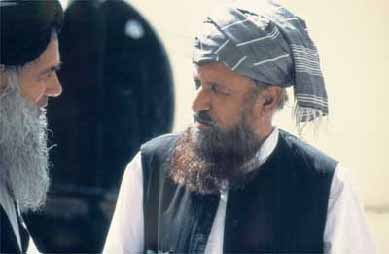
In the dingy office of Maulana Sami al-Haq, three large, glossy photographs rest on a mantel above his disordered desk — photographs of Mr. al-Haq next to his “good friend” Osama bin Laden.
pakistan_guy

Maulana Sami al-Haq, the Haqqania's chancellor, confers with a colleague. -photo by Daniel del Castillo for

Mr. al-Haq is the chancellor of Jamia Dar al-Ulum Haqqania — the University of Religious Sciences — or just Haqqania, as it’s more commonly known. Mr. al-Haq benefits politically in Pakistan from his association with Mr. bin Laden and the Taliban government of Afghanistan, who are often viewed as heroes here for standing up to what is perceived as American aggression against the Islamic world.

In 1994, the religious leaders who make up the Taliban emerged out of Haqqania and other madrassas, which are complexes of schools, seminaries, and mosques for the study of the foundations of Islam. Mr. al-Haq boasts that 90 percent of the Taliban’s ruling elite are Haqqania alumni. Taliban ministers, governors, judges, and members of the ruling Supreme Council append the title “Haqqania” to their names, proud of the prestige of their religious training here.

In the 1980s, the madrassas urged their students to go fight the Soviet infidels in Afghanistan. In 1997, Mr. al-Haq closed Haqqania for a while to send the madrassa’s students to help the Taliban take control of Afghanistan from the warlords who were destroying the country.

The madrassas also have enormous political influence in Pakistan. As a member of Pakistan’s parliament in the mid-1980s, Mr. al-Haq pushed through a bill enacting sharia, or Islamic law. The Pakistani government has supported the Taliban, yet tried to limit the domestic power of madrassas and their graduates, fearing that militant Islamic clerics and their supporters might seize political control of the country. Indeed, thousands of madrassa students took to the streets last week to protest the government’s plans to help the United States take military action in Afghanistan, to retaliate for recent terrorist attacks.

Mr. al-Haq and others at Haqqania are proud of having contributed to the formation of political Islam in the region and of their association with the Taliban. “We have supported the Taliban, and we continue to support them. We think they have implemented Islam in its true shape,” Mr. al-Haq says.

Many Islamic scholars disagree with that view. They say that the Taliban leaders have been far better soldiers than they are scholars, and that no support can be found in the Koran for many of their edicts.
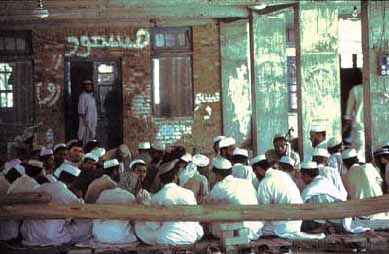
classroom

Classroom - Photo by Daniel del Castillo for The Chronicle of Higher Education

Other Islamic scholars also say that Haqqania’s close ties to the Taliban have sometimes been exaggerated. Qibla Ayaz, a professor of Islamic studies at the University of Peshawar, agrees that the majority of the Taliban government has been educated at Haqqania, but says it is not the only madrassa popular with the Taliban. Haqqania’s chancellor, he says, has political ambitions. “Haqqania has come into the limelight, unfortunately, because of Sami al-Haq,” says Mr. Ayaz. “He has claimed very vehemently in the media that Haqqania is the nursery of the Taliban, and now the Taliban are becoming very popular in Pakistan.”

Haqqania is located here in the Northwest Frontier Province, a lawless region of Pakistan ruled by tribal chiefs and smugglers of arms and hashish. For $1.20, foreigners can buy the protection of an armed guard, and most of them do. Haqqania is an hour out of Peshawar, on Grand Trunk Road, a highway lined with Afghan camps, where refugees seek shelter under canvas tarps and sleep on the ground.

The sprawling university complex spans several acres and has an ornately tiled mosque, a 5,000-seat auditorium, and dormitories where students sleep five to a room. No women are visible: In passing, the chancellor mentions a small satellite campus for them.

The majority of the university’s 3,000 students are Pakistani or Afghan, but they are joined by students from Chechnya, Kazakhstan, Tajikistan, Turkmenistan, Uzbekistan, and even China. The university is selective: Just two years ago, Mr. al-Haq says, 15,000 students applied for 400 places. The university survives on the generosity of benefactors, including alumni, Saudis, and other Arabs in the Persian Gulf region. Its willingness to take students who cannot pay for their education — Haqqania does not charge for food, housing, or tuition — has great appeal. “That is why so many students from the Islamic countries want to come here,” says Abdul Qahar, a Pakistani graduate student. “Many students are looking for recommendations and ways to get in here. More than half of my classmates are Afghan.” Afghan students like Haqqania because the language of instruction is Pashto, a language many of them speak.

Although Haqqania confers bachelor’s degrees, master’s degrees, and Ph.D.’s, Mr. al-Haq and his cadre of ulema — religious scholars — teach nothing from the modern era. Their curriculum is based on the Islamic sciences, including distinct disciplines like fiqh (jurisprudence), tafsir (Koranic exegesis), hadith (the sayings of Muhammad), muntiq (logic), and the Arabic language, which is essential to understanding the Koran.

Mr. al-Haq has a beard like his good friend Mr. bin Laden and carries the highest honorific title possible in his Hanafite sect of Islam, Maulana, meaning “master.” He emphasizes that Haqqania is purely an institution of higher learning, that it doesn’t train or arm militants: “We don’t teach cruelty here, we teach them how to resist cruelty.”

Visiting Haqqania is like being transported to a medieval era, with few touches of modern life. The administration uses five computers to publish a monthly religious journal and keep track of its students. Huge electric floor fans circulate the hot, steamy air in the auditorium.

In classrooms, graduate students wearing prayer caps or turbans sit cross-legged on expansive Oriental carpets, caressing their untrimmed beards, as they listen to lectures. Islamic tradition is memorized here, not discussed.

Students say they aren’t bothered by their isolation. “We are religious students, and in an Islamic society there are people who are studying medicine, engineering, and modern technology. They’ll do their jobs, and we’ll do ours,” says Muhammad Hashem, an Afghan student pursuing a master’s degree in Koranic interpretation.

“I know how to drive a car, and I’ve used a computer. What I want to learn, though, is the technology of tanks and munitions,” he adds, implying that he is ready to join the Taliban’s militant wing. Many students and scholars here believe that the United States is against them solely because they are Muslim. “We have our own culture. We want to wear what we wear and do what we do,” says Maulana Rashid al-Haq, the chancellor’s son and the editor of the monthly journal. “Why is that thought of as something rigid? We have not told America what clothes to wear or to grow beards.”

Rashid al-Haq says the relationship between the Taliban and Haqqania began because of the lack of madrassas in Afghanistan. A combination of Marxist rule, the Soviet occupation, and constant civil war over the last 25 years has kept madrassas from taking root in Afghanistan. War has also pushed two million Afghan refugees into Pakistan, and many of them, in dire poverty, have put their sons in the care of the less-selective madrassas.

“The madrassas were basically built to cater to the needs of orphans and the socially deprived,” says an Afghan scholar in Kabul, the capital of Afghanistan, who is studying the Taliban and requests anonymity for fear of reprisals.

He says that in the modern era, madrassas became insular to protect themselves from the cultural threat of colonialism, and have stayed that way. “They did not incorporate the modern sciences, and the gap between worldly knowledge and ‘spiritual knowledge,’ as the mullahs would call it, widened,” he says.

Many Afghan and Pakistani intellectuals say that much of the responsibility for the proliferation of Islamic groups like the Taliban rests with the United States. During the 10-year Soviet occupation of Afghanistan that began in 1979, the United States pumped billions of dollars for arms and military training into Afghanistan and ignored the rise of religious extremism. Much of the American money for training was funneled through the Pakistani military to people who later joined the Taliban.

In 1996, the Taliban began solidifying their power, taking over Kabul for the first time. In 1997, when Haqqania was temporarily closed, the Taliban assumed control of the majority of Afghanistan and imposed a savagely puritanical version of Islamic law that most Islamic scholars say has no basis in the Koran.

The Taliban has issued a litany of repressive edicts, beginning with Decree No. 1, in November 1996, which it awkwardly translated into English: “Women, you should not step outside your residence.” Education for women, from kindergarten on up, was ended, although Kabul University has recently started training some female doctors.

The Taliban also banned kites, dancing, music, television, the Internet, British and American hairstyles, and photographs “of any living thing.” Punishments are severe: 100 lashes for a woman seen with a man who is not her relative.

In a decree issued within the last two months, the Taliban has announced plans to establish 3,000 madrassas in Afghanistan. But given that the government cannot even feed its own people, that edict is being viewed skeptically by outsiders.

Rashid al-Haq supports the Taliban’s plan for new madrassas in Afghanistan. “We’ll be very happy when those are established because we have to turn so many students away here.”

He sees Islam and politics as inseparable, and the Taliban as a successful example of that union. “Had it not been successful, then America and the opposition that wishes to vanquish Islam would not be creating a clamor.”

_________________________________________________________________

Chronicle subscribers can read this article on the Web at this address:
http://chronicle.com/free/2001/09/2001092104n.htm

If you would like to have complete access to The Chronicle’s Web
site, a special subscription offer can be found at:

http://chronicle.com/4free

_________________________________________________________________

You may visit The Chronicle as follows:

* via the World-Wide Web, at http://chronicle.com
* via telnet at chronicle.com

_________________________________________________________________
Copyright 2001 by The Chronicle of Higher Education
Sept. 11, 2001

FAMILY TIMES
column in Dells Events
September 15, 2001

Originally I was going to write this column about Wo Zha Wa, comparing it to another community party in a tourist town I lived in, Santa Fe, that has a “fiesta” at this time of year.

Then terrorism events on the East Coast interfered with that intention, leaving me with the question of how can we all go on with our lives when such things happen?

How does one ever go on after tragedy? But go on we must. One opinion is that allowing terrorists to disrupt our lives more than is absolutely necessary gives them a greater victory than they already have. Another opinion is that we need to resume activities at our own pace, not having to “prove” anything to anybody.

The truth is there is no way to respond “correctly” to such acts as these. There is no way to show them they haven’t won, to take away what they must surely see as a victory—and what was it they wanted anyway?

We are left with many more questions than answers, and each new development brings more questions and more need to respond in some way, to find someone to blame and make them pay—rather difficult since those who were most dedicated to their cause are already dead.

We are in a new age, beyond the atom bomb, and this is a new and cunning enemy. What is there to be done? I do feel sure that those in positions of power in the United States and other countries of the world will do whatever is possible to prevent terrorism in the future and bring the perpetrators to justice.

So what is to be done here at home? We are left with what to tell our children and what to say to our friends and families. If there is any lesson that could be learned it would be this: the value we place on life and love and peace.

A few years ago there was a movement to teach moral development in the schools. Wonderful curriculum material was available when I was teaching that included creating class discussions on moral dilemmas.

The theory was that moral judgement develops in stages similar to a child’s development of reason. The very lowest stage, that of refraining from bad behavior only because one would get caught and punished, progresses upward to the next stages in which decisions are made because something is illegal, or against the rules, to the higher stages of moral decision making based on universal principles such as the sacredness of life. Children could be encouraged to progress up the ladder by hearing reasoning from someone advocating from a higher stage.

We learned the airliner, that instead of striking its’ target plunged to the ground in Pennsylvania, apparently had a man on board talking on a cell phone. News reports said he knew a plane had crashed into the World Trade Center and he put the phone down and then came back to say the men had taken a vote and had decided to try to overpower the hijackers. Did they know, I wonder, what they accomplished before they died?

The questions and discussions of the moral issues involved are valuable for all of us. If anything, we stop to think and feel and share with each other and our children what we think is right, what we know to be true.

Those heart wrenching last calls to family made by people trapped in the World Trade Center conveyed one message, “I love you.”

The Spiral Path

I have been working on a spiral path in the woods close to the garden. I made it with a lawnmower and have been planting native wildflowers along the edges of the inward path.

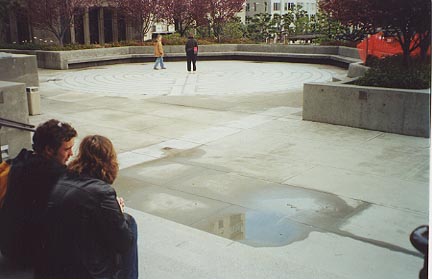
Friend Kristine was here and suggested a rock for the center to mark the middle of the vortex. I have gotten interested in this pattern. When I was in San Francisco I walked the labyrinth at St. Mark’s Cathedral with Cully and Mark. It was way too complicated to duplicate here so I settled on the spiral.

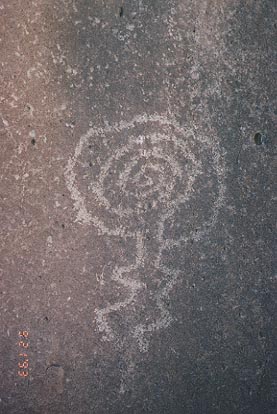
Then I began to find more things about the spiral – including these things below I always had – the photo of a petroglyph on a rock above the Santa Fe River and friend Leslie’s gift a couple of Christmases ago of the Goddess eyes in Malta. I have included links to stuff about spirals that I found and also to some labyrinth sites if you’re interested.


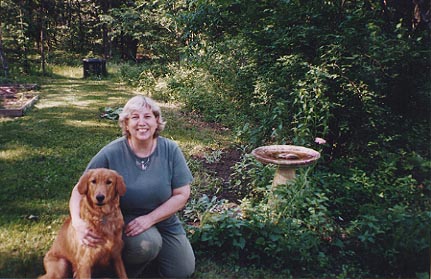
The entrance to the spiral path starts to the right in this picture past the birdbath.

The entrance to the spiral path starts to the right in this picture past the birdbath.


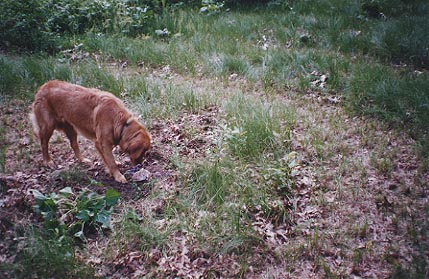
Rosie in the center of the spiral

Rosie in the center of the spiral


Petroglyph near Santa Fe

Petroglyph near Santa Fe


The outdoor labyrinth at St. Mark's

The outdoor labyrinth at St. Mark's


A drawing Leslie sent me a couple of years ago.

A drawing Leslie sent me a couple of years ago.


Getting organized in middle school

FAMILY TIMES
Judy Gibson
Dells Events
Sept. 1, 2001

School doors open and kids and teachers come swarming back with high hopes and optimism for another year.

I always loved this part of teaching; a time it was really possible to start over completely fresh. Fall always feels like the start of the new year, not during the middle of winter, and I always thought Jewish people, who celebrate new year during this season, had the right idea.

One challenge for students I taught in middle school was getting organized. Very few children find organization and planning easy. Middle schoolers are beginning the transition from childhood, where they had a desk in one school room and there was a teacher to help them stay focused, to taking charge of their own learning.

Now they must organize their homework, books and papers and plan study time for different subjects and teachers. Good middle schools like the one here in the Dells have teachers in teams so they can plan together. But it is still up to the students to finish middle school ready to take responsibility for their own learning including some kind of organization for getting work done effectively and on time.

One of the functions of a homeroom teacher where I worked was to help with this very task. I would problem solve with the child, and sometimes also with the parents to get the proper books and papers to the proper classes and then home and back to school again. I remember I suggested a folder in a different color for each class to hold assignments and handouts. That way the student can grab the book and the right folder in a hurry for class or home. Those gigantic notebooks big enough for everything were too overwhelming and heavy for the students I knew. But I’m sure there any many other methods just as effective as the folder option.

Another function of a homeroom teacher in my school was conducting mandatory locker clean-ups and inspections. Nine times out of ten the child would open the locker door to a total chaos of papers, folders, books and various items (some of which I would rather not try to identify) flooding out into the hall.

Some students creatively built little shelves to keep things organized and I know these days locker organizers are probably available, but this task “getting organized and having the right stuff at the right time”is one of those things learned well at school.

At some point my daughter went from horribly messy (having a bedroom that had little paths through all the stuff) to being quite neat and organized which she is to this day.

Of course being organized and efficient can be taught at home, but I think schools do it well. The rewards are immediate and obvious – having that homework done, in the right folder, and carried to class to hand in on time.

It’s the little things “don’t you think?” that make life easier.


Road America, the Motorola 200 -August 19, 2001

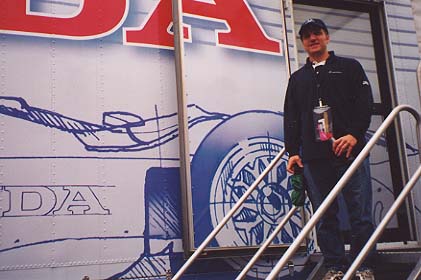
honda_todd

Todd at the Honda trailers where he used to have to spend all his time at the races. Two semis full of engineers with computers.

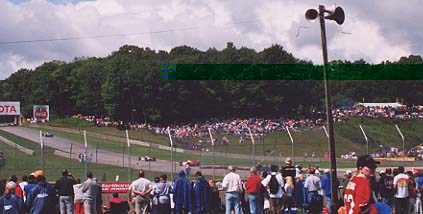
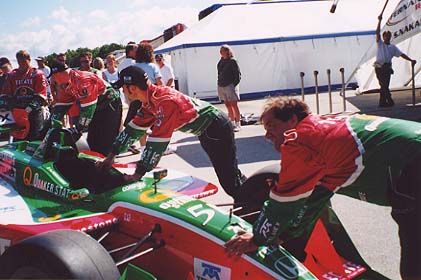
I had the treat of a guided tour of the race from a Motorola engineer, son Todd, who works on the electronics for all the CART Honda engine cars that includes the Motorola car driven by Michael Andretti that came in second.

mot_220

Final Results
B. Junqueira Toyota/Lola/Firestone
M. Andretti Honda/Reynard/Firestone
A. Fernandez Honda/Reynard/Firestone
S. Dixon Toyota/Reynard/Firestone 45
G. de Ferran Honda/Reynard/Firestone
C. da Matta Toyota/Lola/Firestone
H. Castroneves Honda/Reynard/Firestone
A. Tagliani Ford-Cosworth/Reynard/Firestone
P. Carpentier Ford-Cosworth/Reynard/Firestone
O. Servia Ford-Cosworth/Lola/Firestone
R. Moreno Toyota/Reynard/Firestone
T. Kanaan Honda/Reynard/Firestone
A. Zanardi Honda/Reynard/Firestone

station_5

Station 5 where all the spinouts happen


tecate

The Tecate car, driver Adrian Fernandez is at the far left.


blank

(Missing: franchitti.jpg)

Old Family Photos – Fall 2001

san_franfam_in_SFmark_s_lab

Dad_and_Rosie

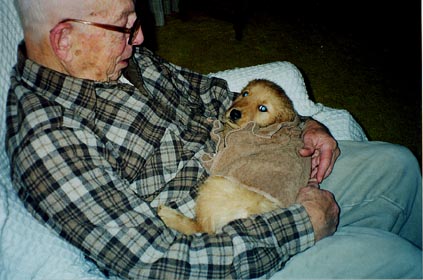
Grandpa and puppy Rosie after a bath

Moms over 40

FAMILY TIMES
Judy Gibson
Dells Events
Aug. 4, 2001

Nancy’s great book about first time moms in midlife

nancy_s_book_2b

Nancy London starts her book, “Hot Flashes and Warm Bottles” with a story about how she fell asleep out of sheer exhaustion before she could leave her nine-year-old daughter a gift from the tooth fairy.

This tale of a “first-time mother over forty” continues with the jolt she had in the morning when her daughter came sobbing into the kitchen because the tooth fairy hadn’t come.

“Good grief,” thought Nancy, “I’m too tired to be the tooth fairy.”

With first hand experience on the issue and a background as a licensed therapist in Santa Fe, Nancy realized she might not be the only one in this position so she set about putting together a support group for first-time mother’s over 40 and then pulled it all together in a book.

Anyone who has eagerly waited for a child for more than 40 years, perhaps going through fertility treatments, will relate to the experiences in the book of women who have such mixed feelings about finally having a child only to realize that they are in the time of their own lives that they could be winding down a bit for a well deserved rest.

This dichotomy creates a kind of psychological dissonance that can devastate an woman and her family. The wonderful, very much wanted child, sometimes taxes the older mom to the limit.

London was one of the original members of the Boston Women’s Health Collective and one of the writers for the book “Our Bodies Ourselves” published in the late 60s.

“I believed we could have it all, be it all, do it all . . . it has been a gradual awakening on my part to understand that choices we make do bear consequences.”

She begins with an unstinting look at her own experience, finally carrying a child to term after several devastating miscarriages in her 30s, delivering a beautiful, healthy child at 43. She writes at that time she felt young, vital and capable of juggling it all, but nine years later she was exhausted, impatient and irritable with “a growing desire for solitude.”

The book is divided into chapters dealing with such topics as menopause and balancing work and motherhood, and goes on to include information and supportive tips on the infertility mill and adoption. She also has a chapter for those moms who have a second family after 40 and includes stories from single mothers and lesbian moms.

When Nancy put out a notice for interested women in the Santa Fe area she was flooded with calls and now gets inquiries from all over the country as many more women delay childbirth. From 1980 to 1995 the birth rate for women from 40 to 44 increased 81 percent.

Life issues at 40 are very different than at 30, and perhaps more relevant are the life stages of mom (and dad) as the child grows up.

I talked to Nancy while I was in Santa Fe recently and she told me she had heard of a 60-year-old woman who had a baby in California with the help of a donor egg and hormone treatments. The “envelope”of the birth experience keeps getting pushed.

This timely book would be a help to anyone already in the situation, contemplating having a child, or for professionals dealing with the older mother.

One of the charming things about the book are Nancy’s tales about her own daughter. She interviewed her for the book to help give the child’s perspective.

Her daughter told her, “Sometimes you’re tired right after you wake up, and it’s like HELLO – that’s a really quick day.”

“Hot Flashes Warm Bottles” is available from Celestial Arts on Amazon.com.

Marriage is like a canoe trip

FAMILY TIMES
Judy Gibson
Dells Events
July 28, 2001

One thing I used to love doing with my children and various friends when I lived in Minnesota was to take a canoe trip in the Boundary Waters Canoe Area (BWCA). In this place, inaccessible except by canoe, it is possible to travel for days, weeks, even months without leaving an extensive wilderness area.

Since I have taken many trips with various people, I formed a theory that a BWCA trip is a microcosm of the relationship of those who travel together.

My second husband and I made a trip together, arguing the entire time in a sort of power struggle. Indeed, that characterized a relationship that reflected a need for both of us to wield power over the other.
A woman I shared this theory with said it proved true for her, too. She and her husband took a trip before their marriage that was sunlit days of enchantment and happiness with a few moody times thrown in. That has been the story of her marriage, she said, wonderful most of the time interspersed with occasions when her husband goes into a funk.

Marriages, intimate relationships that they are, bring out the best and the worst in us. The manuals on making marriage work are numerous and repetitive – stressing communication skills and mutual values.

One concept that has always helped me in my own life and also in my work with couples has been a concept from psychoanalyst Carl Jung about the ways that we look outside ourselves for our incompleteness inside. He calls it the “animus” and the “anima” – the inner male and the inner female. Jung says that all of us carry a mirror of our gender and things can go awry when those aspects of ourselves are not acknowledged. One way this comes out is in seeking a partner that somehow fits these internal pictures and serves to “complete” the person like the famous line in the movie “Jerry Maguire” – “You complete me.” We hope to find, and then create the reality of a partner that can do for us what we cannot do for ourselves.

There lies the trap.

Couples who have been married for many years have negotiated the mine field of this disappointment, for surely a disappointment it is when the other fails to live up to the projection of the inner need. My parents generation had it a little easier, I think, since female and male roles were more defined. Expectations were clearer.

In this new century male and female roles are all mixed up; yet each of us still carries within us the ideal of a partner who will fulfill us. The conservative, cautious man marries a funloving, adventurous woman. They may balance each other for awhile, but eventually the roles can become a prison.

When I married for the second time we had a pre-ceremony conference with the minister. He asked both of us what about this new marriage would make it more likely to last than the last one.

I said, “I think I’ve changed a lot since then.”

He replied, “My dear, don’t you think you will change again?”

He was right. Adapting to the changing partner is nearly impossible if we hold them to the image of the ideal we need to complete ourselves.

The answer is, of course, to work on completing ourselves without looking to each other. This is what I used to encourage in couples I counseled who were having difficulty. Often one or both would be waiting for the other to do something they wanted and expected, while the spouse was on to something else – exploring some other aspect of his or her growth.

I would be able to tell if a couple would make it through the rocky times almost immediately in the first few minutes of the first session. It was an intangible – something that could nearly be felt in the air, and I can only describe it as the love between them or maybe the level of commitment to the marriage.

I maintain that everyone who marries will need at some point to deal with this issue of internal projections. How they resolve it together is unique to each couple, but whether they do it at all depends on the degree of their love for and commitment to each other.

Photos – Jan 2001

I had a wonderful time with Cully and Mark in California.
We discovered Diablo Mountain state park and another place
with cascades and stairs, very Frank Lloyd Wright feeling.
The weather, of course, was gorgeous every day.

cully_in_office

Cully in her office at UC Berkeley

cat

Lincoln (California cat)


And on to Chicago and the Chicago Fire game

I loved this game. The Fire played the New England Revolution and
after two 5-minute sudden death overtimes, they ended the game still tied 1-1.

Announcements were in English and Polish. Todd said sometimes they were in Spanish too.


fire_game


todd_bbq

Todd making shish-ka-bobs at home on Graceland Ave.


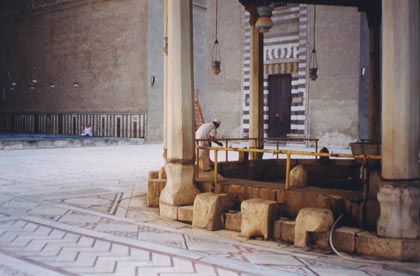
Photos from a trip to Cairo and Luxor, Egypt, October, 1999

Kahn_al_KaliliKarnak_and_judyegypt_giza_policemanmosqueel_gaziraegypt_farmers_market